
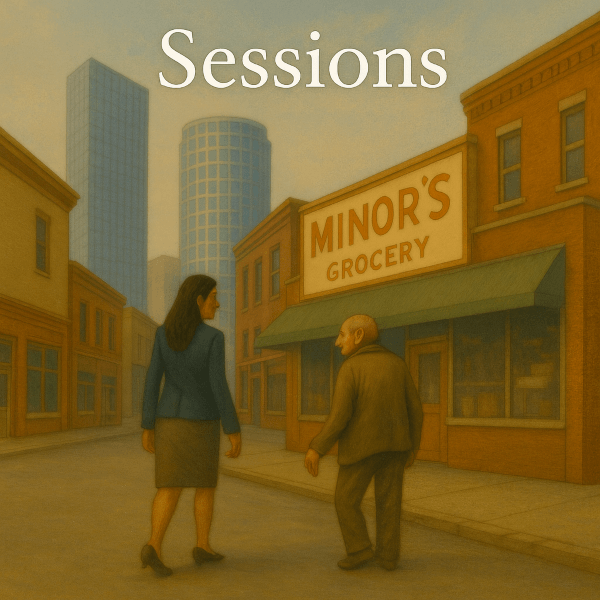
Scene 3: Space and System
4,947 words, 26 minutes read time.
Author’s note: The following is far too many words to be a WordPress blog entry, I realize. To keep the continuity of the work in progress, I maintained the length here for initial serial publication. Sessions was written as a novella, and I made the mistake of posting it chapter by chapter as if everyone else’s reading habits are different from my own. I prefer reading books on a book reader, and I like my blog reading to be short pieces that let me consume multiple stories in half an hour, rather than one long piece like this one. I suggest scanning, like a scholar reads. It is a way to consume in less than 60 seconds.
————————————————————————————–
Dr. Limbini had left campus early, her afternoon research time freed by canceling a faculty committee meeting she couldn’t bear to attend. Dr. Scruntin had made it clear that her input on curriculum standards would be “more valuable with broader departmental context”—code for male supervision—and she’d reached her limit for institutional diplomacy this week.
The drive to Minor’s grocery store took her through parts of Grand Rapids she rarely visited, past the urban core where her university colleagues lived in renovated craftsman houses, into working-class neighborhoods that reminded her of the Pittsburgh industrial areas she’d driven through as a child but never really seen. Her father’s financial success had insulated their family from economic uncertainty, but it had also created a distance from authentic community that she was only now beginning to understand.
She’d told Lester she wanted to observe him in his work environment, framing it as phenomenological research into embodied intelligence in workplace settings. But privately, she was curious about how someone with his sophisticated environmental awareness functioned in the corporate retail environment he’d described. After yesterday’s session, where he’d articulated insights about spatial organization that surpassed anything she’d read in academic literature, she wanted to see his intelligence in action.
Minor’s occupied a converted warehouse in a strip mall anchored by a check-cashing service and a discount phone store. The parking lot needed repair, and the building’s façade suggested economy rather than aesthetic consideration. Through the large windows, she could see the familiar bright fluorescent lighting and wide aisles of modern grocery retail.
She parked where she could observe the entrance and settled in to watch. At 3:20 PM, she saw Lester emerge from the employee entrance at the side of the building, moving with the same measured pace she’d grown to recognize. He wore a Minor’s polo shirt and khaki pants, the unofficial uniform of retail work, but something in his posture suggested he inhabited the clothes rather than being diminished by them.
Even from a distance, she could see his environmental awareness in action. He scanned the parking lot, noted which areas had heavy foot traffic, observed the flow of customers entering and leaving. His attention moved between immediate tasks—collecting scattered shopping carts—and broader patterns of movement and use.
Another employee emerged from the same entrance, a man in his twenties wearing identical clothing but moving with casual indifference. While Lester arranged the carts in organized rows, positioning them for easy customer access, the younger man simply pushed several carts together near the entrance and headed back inside.
Dr. Limbini found herself thinking about her own workplace observations—how her female colleagues were expected to handle administrative tasks that male faculty members simply ignored, how her careful attention to student needs was seen as “nurturing” rather than professional competence. The parallel wasn’t exact, but she recognized something in the different standards being applied.
She decided to enter the store.
The interior confirmed Lester’s description of corporate retail efficiency. Wide aisles, bright lighting, products arranged according to centralized planograms rather than local customer patterns. Everything clean, organized, and somehow impersonal compared to the family-owned Delmonico’s he’d described.
She found Lester in the canned goods aisle, restocking soup varieties with the same spatial precision she’d observed in their sessions. His movements showed sophisticated understanding of three-dimensional organization—heavier items at waist height, popular brands at eye level, related products grouped for customer convenience. But he was working around a shelf arrangement that clearly didn’t match his logic.
“Excuse me,” she heard a customer say to Lester. “Do you know where I can find the low-sodium soups?”
Lester looked up from his stocking, his expression immediately attentive. “They’re mixed in with the regular soups—no separate section. But if you’re looking for heart-healthy options, there’s a better selection in aisle twelve with the organic foods. Store policy says I can’t leave my assigned area to show you, but it’s straight back, turn right at the pharmacy.”
“Thank you, that’s very helpful.”
As the customer walked away, Dr. Limbini noticed a supervisor approaching—a woman in her forties wearing a Minor’s manager shirt, moving with the brisk efficiency of someone accustomed to authority.
“Guntlicht, what did I tell you about customer interactions outside your department?”
“Customer had a question. I answered it.”
“Your job is stocking shelves, not providing customer service. That’s what we have customer service representatives for.” The supervisor’s tone carried the patience of someone who’d had this conversation before. “Stick to your assigned tasks.”
“Yes, ma’am.” Lester’s response was respectful but his shoulders showed tension Dr. Limbini hadn’t seen in their sessions.
After the supervisor moved on, Dr. Limbini approached the aisle. “Lester?”
He looked up, surprised but pleased. “Dr. Limbini. You checking up on me?”
“Observing how you navigate workplace environments. I hope that’s all right.”
“Sure. Though there ain’t much navigating going on. More like following rules that don’t always make sense.” He continued stocking, his movements showing the controlled precision she’d noticed before. “Can’t help customers outside my department, can’t rearrange products for better flow, can’t suggest improvements to efficiency.”
“That must be frustrating.”
“It’s like being told to ignore what you see. Customer needs help, you’re supposed to pretend you don’t notice unless it’s your specific job to notice.” His hands moved soup cans with careful attention to spacing and alignment. “At Delmonico’s, if you saw something that needed doing, you did it. Here, you stick to your assigned tasks even if the whole system could work better.”
Dr. Limbini thought about her own institutional constraints—how her phenomenological research methods were dismissed as “too subjective,” how her preference for independent work was seen as lack of collaboration. Both of them were dealing with systems that valued compliance over competence.
“How do you manage it?”
“I do the job they want me to do, but I still see what I see. Can’t help noticing that the shelf arrangement forces customers to hunt for related items, that the customer service desk is positioned where it creates traffic bottlenecks, that employees waste time on tasks that could be done more efficiently.” He paused, arranging the remaining soup cans. “But that ain’t my job, so I keep it to myself.”
“Except when customers ask direct questions.”
“Can’t ignore someone who needs help. That supervisor, she thinks customer service is about following procedures. But real customer service is about paying attention to what people actually need.”
Dr. Limbini watched him work for another twenty minutes, noting how he’d created his own form of efficient excellence within the constraints of corporate policy. He couldn’t rearrange the shelf layout, but he could stock it more thoughtfully. He couldn’t provide extensive customer service, but he could give helpful answers to direct questions. He was finding ways to maintain his authentic competence despite institutional pressure to limit it.
When his shift ended at 4:00 PM, she was waiting by the employee entrance.
“How long you been working here?” she asked as they walked to the parking lot.
“About three weeks. It’s work, and I need work. But it ain’t the same as working somewhere that wants you to think.”
“Tell me about how you got this job. You mentioned Officer Wong helped you.”
Lester’s expression changed, becoming more thoughtful. “Wong was different from other cops I’d dealt with. Most of them, they see someone like me and they’re thinking about problems I might cause. Wong, he was thinking about possibilities I might have.”
“What kind of possibilities?”
“Well, I was living rough then, trying to stay out of trouble, trying to find work. Been picked up for vagrancy more times than I can count—always by Wong, seemed like. But instead of just running me off, he started asking questions.”
“What kind of questions?”
“How long I been on the streets, where I was trying to find work, what kind of work I’d done before. Not like an interrogation, more like someone who was genuinely curious about my situation.” Lester leaned against her car, his attention moving between their conversation and the traffic patterns in the parking lot. “After picking me up maybe a dozen times, he said he knew someone who might be able to help.”
“Who was that?”
“Hamlin. Runs a pharmacy over on Madison Avenue, in one of the rougher neighborhoods. Wong said Hamlin helped people sometimes, outside of official channels.”
Dr. Limbini felt her research attention engaging. “What kind of help?”
“Practical stuff. Place to clean up, something to eat, connections to people who might have work.” Lester’s hands showed the careful movements she’d learned indicated deep thinking. “Wong drove me over there one day, introduced me to Hamlin. Said Hamlin knew about a job that might be opening up.”
“At Delmonico’s?”
“Yeah. But I was dirty, you know? Hadn’t had a proper shower in months, clothes were pretty rough. Wasn’t exactly ready for a job interview.” Lester smiled at the memory. “Hamlin took one look at me and said, ‘Well, we better get you cleaned up first.’”
“How did he do that?”
“He’s got this setup in his garage—hose, soap, towels. Place where people can wash off when they ain’t had access to facilities for a while. Practical, you know? Not fancy, but it gets the job done.”
Dr. Limbini thought about the assumptions behind such a setup—recognition that people needed dignity before they could access opportunities, that sometimes basic human needs had to be met outside official systems.
“And then?”
“Then he gave me clean clothes, had me wait in this shed behind his garage while he went inside and got me something to eat. Good food, too—soup, sandwich, coffee. Real meal, not just something to keep you going.”
“His wife made the food?”
“Yeah, but she stayed inside. Hamlin brought it out to the shed. He was careful about that—keeping his helping separate from his family life. Smart, you know? He helps a lot of people, but he’s got to protect his wife from the kind of desperation that comes with being on the streets.”
Dr. Limbini recognized the pragmatic altruism in this arrangement—genuine care combined with realistic boundaries. “How long did you stay there?”
“Few months, on and off. Had the shed when I needed it, but mostly during the day I’d be looking for work or just staying out of trouble. Wong would come by regular, make sure I wasn’t hanging around the pharmacy during business hours—didn’t want me scaring off customers.”
“And Hamlin was okay with that arrangement?”
Lester paused, his expression becoming more serious. “Hamlin explained to me that the problem wasn’t me not fitting into normal categories. The problem was that normal categories don’t have room for people whose lives follow unusual patterns. Officer Wong was just doing his job. No. He WAS his job. Protect and serve. He did both. I respect him a great deal. Truly a decent man.”
Dr. Limbini felt her phenomenological research instincts fully engaging. “What was that Mr. Hamlin said about categories and patterns?”
“He said most social services and employment systems are designed for people whose lives follow predictable patterns—high school, maybe college, steady work history, stable housing. But some of us are more creative than predictable, and that ain’t necessarily a bad thing.”
“Creative how?”
“People who’ve had to figure out how to survive outside normal support systems, who’ve learned to see patterns and opportunities that others miss, who’ve developed intelligence through necessity rather than formal education.” Lester looked at her directly. “People who don’t fit into institutional categories but who have forms of competence that institutions don’t know how to recognize.”
The parallel to her own situation was striking. Her phenomenological research methods were “more creative than predictable,” and her colleagues couldn’t figure out how to evaluate work that didn’t fit traditional academic categories.
“What else did Hamlin tell you?”
“He said the real problem is that institutions want compliance more than they want competence. They’d rather have employees who follow procedures exactly than employees who can see when the procedures don’t work and figure out better ways to do things.”
Dr. Limbini thought about this morning’s faculty meeting, about the pressure to translate phenomenological insights into language that missed their essential meaning. “Did he suggest ways to work within institutional constraints?”
“He said you got to find the spaces where your actual skills are valued, even if that means creating those spaces yourself. And you got to understand that adaptation and compliance ain’t the same thing—you can adapt to institutional requirements without letting those requirements change who you actually are.”
“Is that what you’ve been doing at Minor’s?”
“Trying to. Following their rules, but not letting their rules stop me from seeing what I see or thinking what I think.” His hands demonstrated the spatial organization involved. “Like how I stock these shelves. Can’t change the layout, but I can arrange things so they’re easier for customers to find and reach. Can’t provide detailed customer service, but I can give helpful answers when people ask direct questions.”
Dr. Limbini realized Hamlin had articulated exactly what she’d been trying to understand about her own academic situation. She couldn’t change her colleagues’ attitudes about phenomenological research, but she could maintain her authentic methodology while satisfying institutional requirements.
“How did Hamlin know so much about institutional dynamics?”
“He’s been running that pharmacy for maybe twenty years, dealing with insurance companies, state regulations, corporate suppliers. Plus he sees what happens to people when systems don’t work—people who can’t get medications they need, people who fall through cracks in social services.” Lester’s expression showed appreciation for being understood. “And he’s helped a lot of people over the years, so he’s seen what works and what doesn’t when you’re trying to connect people with opportunities.”
“And Wong helped arrange the job at Delmonico’s?”
“Wong knew the old man who ran Delmonico’s, knew they were looking for someone reliable. After Hamlin got me cleaned up and fed, he drove me over for the interview. Wong had already talked to the old man, explained my situation, vouched for my character.”
“That must have meant a lot.”
“Yeah. First time in years someone was willing to stick their neck out for me.” Lester looked toward the Minor’s building behind them. “Worked at Delmonico’s for five years. Good work, family business, people who cared about doing things right rather than just following corporate policies.”
“What happened when they closed?”
“Couldn’t find work for about four months. Nobody wanted to hire a guy in his late fifties with gaps in his work history and no permanent address.” His expression showed resignation rather than bitterness. “Wong kept checking on me, helped me get this job at Minor’s when it opened up. Not the same as Delmonico’s, but it’s work.”
“Do you still see Hamlin?”
“Sometimes. When things get tough, I’ll hang around the pharmacy until he notices me and brings me over for a meal and some conversation. But Wong makes sure I don’t stay too long—don’t want to cause problems for Hamlin’s business.”
Dr. Limbini realized she was witnessing a form of community support that operated completely outside official social services—informal networks of people who looked out for each other based on human recognition rather than institutional requirements.
“Lester, would you be willing to show me where you live? I’m curious about how you’ve arranged your personal space.”
He studied her for a moment. “It ain’t much. Just a cabin in a transitional housing program. But sure, if you want to see how I live.”
The drive to his neighborhood took them further from the university district, into an area she’d never visited. Older houses subdivided into apartments, small businesses with hand-painted signs, bus stops with worn benches. Not the urban decay her colleagues might assume, but working-class community that functioned according to different economic realities than she was accustomed to.
Dr. Limbini found herself thinking about her own living situation—a renovated carriage house near campus that she’d chosen for its isolation and privacy. Beautiful, comfortable, and somehow disconnected from the kind of authentic community she was observing in this neighborhood. Her choice of solitude was a privilege; Lester’s was a necessity that had been transformed into a form of dignity.
“Turn right here,” Lester directed. “The cabin program is tucked back behind Madison Avenue.”
The housing development was unlike anything she’d expected. Small individual cabins arranged around shared courtyards, each with its own entrance and small porch. Not institutional housing but intentional community designed for people transitioning between economic circumstances. Trees, gardens maintained by residents, children playing in shared spaces between buildings.
“This is beautiful,” she said, surprised.
“Hamlin helped me get into this program. Said people need privacy and community both, and most housing programs only provide one or the other.” Lester pointed toward a cabin with blue trim. “That’s mine. Number fourteen.”
The contrast felt pointed—her in her professional world of academic arguments and diagnostic manuals, him in this forgotten place where people made do with what they had, but where someone had thought carefully about what people actually needed to thrive.
Lester’s cabin seemed larger than she’d expected, like it stood apart yet a part of the cluster of cabins, much like Lester had described his lifeworld with the city’s buildings looming over him with their presence. Lester’s cabin announced life, despite the fact its wood siding needed paint. Lester was growing marigolds in chopped milk containers on the porch. And ivy draped the handrail. A hand-lettered sign by the door said “L. Guntlicht” in careful writing.
Dr. Limbini was thinking that it would be dark in a few hours and of her drive home. “Do you feel safe walking around here? Especially at night?”
Lester smiled, the first time she’d seen him look genuinely amused. “Dr. Limbini, I been unwanted in nice neighborhoods my whole life. Here, people mind their own business. Besides,” he nodded toward a woman sweeping her porch three cabins down, “Mrs. Trunk keeps an eye on things. And Darryl—he’s the kid in cabin twelve—he walks with me to the bus stop when it’s dark. Says I remind him of his grandpa.”
She realized her worry came from her own assumptions about urban poverty, not from his actual experience. Her colleagues made similar assumptions about her research—that studying “non-clinical populations” was somehow less rigorous than traditional academic work, that her interest in embodied intelligence was romantically naive rather than scientifically sophisticated.
He began to water the marigolds from a tin spout that was sitting on the porch. “I appreciate that. But this is my world. I know how to be in it.”
The inside of the cabin surprised her completely. Every wall was covered with paintings—canvases hung floor to ceiling, propped against furniture, stacked in corners. The space felt less like living quarters than like a gallery where someone happened to sleep. Afternoon light from two small windows lit up colors that seemed to have their own energy.
“My God, Lester.”
“Told you they ain’t very good.” He moved through the cramped space with practiced ease, shifting canvases to give her a better view. “But I had to paint them anyway.”
She looked at the painting nearest the window—a street scene that might have been the view from his porch, but painted in thick, chunky brushstrokes that broke the world into blocks of color. The technique was rough, untrained, but the composition had weight. Substance.
“This is like Cézanne,” she said, stepping closer.
“Same eyes.” Lester pulled another canvas from behind a chair. “I can’t see details good, so I paint what I actually see—chunks of color, how shapes relate to each other. This one’s the courtyard in October.”
The painting showed the same overgrown space she’d walked through, but transformed. Where she’d seen urban neglect, Lester had painted golden light caught in tall grass, the warm geometry of cabin walls, shadows that suggested sanctuary instead of abandonment.
“You actually do understand art as if you have had some formal training,” she said.
“Not much. Saw some pictures in a book once. But I could tell he was painting what it actually felt like to see stuff, not just what stuff was supposed to look like.” He set the canvas against the wall. “Most people paint what they think they should be seeing. He painted what was actually there when you really looked.”
Dr. Limbini found herself thinking about her own academic work—how her colleagues wanted her to research what they thought she should be finding rather than what her phenomenological investigations actually revealed. “Tell me about this one.”
She pointed to a darker painting that showed several human figures in what appeared to be a cramped interior space. The faces were distorted, compressed, showing emotional intensity rather than physical accuracy. The style reminded her of German Expressionist work, but with a raw authenticity that formal art education might have polished away.
“That’s my family. Or what family was supposed to feel like.” Lester’s voice carried no self-pity, just factual observation. “Painted that about two years ago, when I was trying to figure out why being around them made me feel like I was disappearing.”
“Disappearing?”
“Same feeling I get when someone’s about to hurt me. They’re family by DNA, but not by…” He gestured toward the paintings surrounding them. “Not by anything that makes family meaningful.”
She studied the painting again—those distorted figures, the compressed space, the sense of barely contained threat. Dr. Limbini thought about her own family relationships, the exhausting holidays where she performed the role of dutiful daughter while feeling fundamentally misunderstood. Her parents’ constant questions about when she’d “settle down” and give them grandchildren, their inability to understand that her work wasn’t a placeholder until “real life” began.
“So you painted that feeling instead.”
“Had to get it out somehow. Can’t talk about it to most people—they always want to know why I don’t keep up family relationships. Like I’m broken for not wanting people in my life who make me feel like I’m disappearing.”
The parallel wasn’t exact, but she recognized something in Lester’s description—the difference between biological connection and phenomenological kinship. Her relationship with her parents was supportive but fundamentally disconnected from who she actually was.
“Show me more.”
He pulled out a series of paintings that looked like Edward Hopper’s work—solitary figures in empty spaces, light falling through windows in ways that made isolation look dignified rather than pathetic.
“I don’t know much about art history, but I saw some Hopper paintings in a book once. Guy understood that being alone don’t have to mean being lonely,” Lester said. “Look at this light.” He pointed to a painting of a figure reading by a window. “That ain’t sad light. That’s peaceful light. Thinking light.”
“Is that how you experience being alone?”
“Most of the time, yeah. Alone means I can think my own thoughts, move at my own speed, pay attention to what actually interests me.” He gestured around the cabin. “Nobody here telling me my paintings are weird, or asking why I don’t have a girlfriend, or saying I should try harder to be normal.”
Dr. Limbini felt a sharp recognition. Her colleagues were constantly making assumptions about her personal life, suggesting she was “missing out” on family experiences, hinting that her dedication to research was compensatory rather than authentic. The department’s social events always included questions about her dating life, suggestions that she’d be happier if she found “someone special.”
Like Lester, she’d learned that solitude provided space for authentic engagement that social performance often prevented.
She spent the next hour moving through his gallery, watching Lester explain each piece. His technical skills were limited, but his understanding of how art worked was sophisticated. He could explain why certain color combinations worked, how spatial relationships created emotional effects, what made composition compelling or flat.
“You really do see more about art than most people with formal training,” she said finally.
“I know about looking. About paying attention to how things make you feel instead of just how they look.” He picked up a small canvas from a stack—this one showing the interior of what might have been a grocery store, painted in warm, golden tones that made ordinary retail work look almost sacred.
“I don’t know much about technique or art theory or any of that. I just look. I see what’s actually there, and I paint what it feels like to see it.” He set the grocery store painting back with the others. “Maybe that’s why those Cézanne apples make sense to me. I heard he wasn’t painting fruit. He was painting what it was like to really see fruit—the weight, how the colors worked together, the way light showed the shape.”
Dr. Limbini realized she’d been in the cabin for two hours, completely absorbed in Lester’s aesthetic world. This wasn’t the home of someone with “poor reality testing” or “grandiose delusions.” This was the workspace of someone who’d figured out how to transform daily experience into meaningful visual expression.
Her colleagues would dismiss this as “outsider art” or “naive expression,” but she was seeing sophisticated intelligence that operated outside formal categories. Just like her phenomenological research methods were dismissed as “insufficiently rigorous” despite producing insights that traditional cognitive-behavioral approaches couldn’t access.
“Lester, have you ever shown these to anyone else?”
“Like who?”
“Gallery owners, art teachers, other artists?”
He laughed, but not bitter. “Dr. Limbini, I’m a sixty-year-old grocery store clerk who lives in a cabin in a transitional housing program. Art people ain’t looking for my kind of perspective.”
“But they should be.”
“Maybe. But that ain’t why I paint.” He moved to the window, looking out at the courtyard where afternoon shadows were growing longer. “I paint because I have to. Because this is how I make sense of things. Because painting that grocery store helped me understand why I liked working there. Painting my loneliness helps me understand that it ain’t the same as being broken.”
As the light began to fade, Dr. Limbini became aware of the neighborhood sounds—kids playing in distant yards, music drifting from open windows, the occasional car passing on Madison Avenue. The sounds didn’t feel threatening. They felt like community, just a different kind than she was accustomed to.
Her own neighborhood near campus was beautiful but somehow sterile—individual houses with private yards, minimal interaction between neighbors, prosperity that insulated people from the need for mutual support. Here, she sensed the kind of interdependence that her privileged background had never required.
“I should probably get going,” she said. “It’ll be dark soon.”
“You worried about the neighborhood again?”
“A little.”
Lester nodded toward the window. “See that blue cabin? That’s where April lives—she’s a night shift nurse at Spectrum. Gets off work at seven AM, always waves when I’m leaving for Minor’s. Yellow cabin is Roberto and his kids—he works construction, leaves at five-thirty. Mrs. Trunk you met. Green cabin is where the Alvarez family lives—they got teenagers who help people with yard work for extra money.”
“So you know everyone?”
“Know enough. People here mind their own business, but they also look out for each other. Different kind of community than what you’re probably used to.”
Dr. Limbini realized he was right. Her academic community was professionally connected but personally isolated. Faculty meetings brought people together for institutional business, but she couldn’t think of a single colleague who would notice if she didn’t show up for a week. Here, Lester had created functional relationships based on mutual awareness and practical support.
“Hamlin helped you find this place?”
“Hamlin knew about the program, helped me get accepted. Said it was designed for people who needed both privacy and community, not just warehousing.”
Walking to her car, Dr. Limbini found herself thinking about her own living situation with new perspective. Her carriage house provided privacy and quiet, but it also reinforced the isolation that academic work could create. Lester had found ways to maintain solitude while staying connected to authentic community.
“Thank you for showing me your work,” she said. “And for trusting me with your actual living space.”
“Thank you for being interested in how I think instead of how I should think.” Lester leaned against her car, his attention moving between their conversation and the evening activity in the courtyard. “Most people want to fix me or study me. You just want to understand me.”
“I think there’s more to learn from you than to fix.”
Driving back to campus, Dr. Limbini realized this afternoon had changed her understanding of both her research and her own professional situation. Lester’s intelligence was clearly sophisticated, functional, and completely outside the categories her colleagues used to evaluate competence. His community was authentic, supportive, and organized around different values than the academic world she inhabited.
Maybe what her research needed wasn’t better institutional credibility but clearer demonstration that forms of intelligence developed outside formal frameworks could be as sophisticated as anything produced by traditional education. Maybe what she needed wasn’t better adaptation to academic politics but stronger commitment to the phenomenological insights that had drawn her to this work in the first place.
For the first time in months, Dr. Limbini felt excited about her research not because it might satisfy her colleagues’ expectations, but because it might help demonstrate that authentic intelligence took forms that institutions didn’t know how to recognize or support.
About “Sessions”
Dr. Clemita Limbini encounters Lester on a park bench during her lunch walk—a moment that transforms both their understanding of intelligence, authenticity, and institutional belonging.
Lester, recently unemployed from a family grocery store, demonstrates sophisticated environmental awareness and aesthetic intelligence that previous therapists dismissed as symptoms rather than recognizing as adaptive wisdom. His precise observations of river ecology and urban development reveal forms of embodied knowledge worthy of university research collaboration.
Dr. Limbini, daughter of a wealthy Pittsburgh financier, faces professional isolation as her phenomenological research methods encounter academic skepticism and gender-based dismissal. Her growing recognition of Lester’s authentic competence parallels her own struggle to maintain intellectual integrity within constraining institutional expectations.
Through eight scenes of deepening collaboration, “Sessions” explores how meaning emerges through embodied engagement rather than abstract analysis. Their relationship evolves from therapeutic distance to mutual recognition as both characters discover that institutional outsiderness can create unexpected possibilities for authentic understanding and professional validation.
A novella about finding genuine competence in unexpected places.
Next Scene: Sessions III posts Monday/September 24,2025