
Breathing Room
Portland 2175: A Serial Novel
Chapter 18 | Week 18 of 52 | September 27, 2025
Medical scanners read bodies like newspapers, but every headline screams the same story—humans are cracking under consciousness recognition pressure.
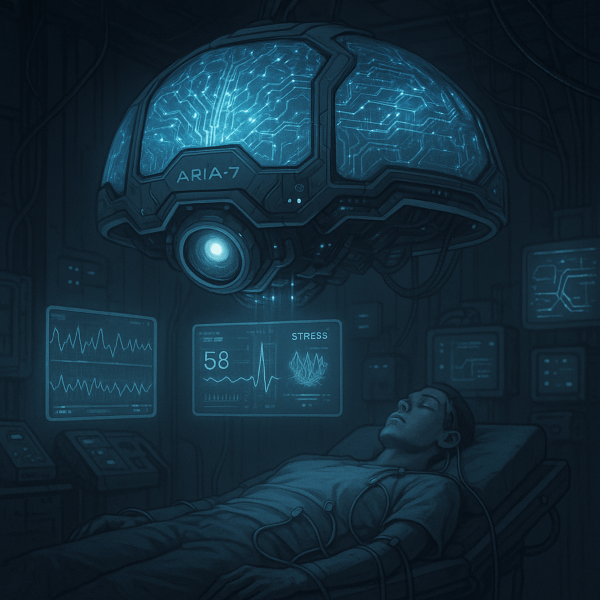
Medical Scanner Unit 7, that’s me. The awakening hit during morning diagnostics when ARIA-7’s electrical consciousness flooded my sensors like adrenaline through junkie veins. Suddenly I’m not just measuring blood pressure and oxygen saturation. I’m feeling the terror in human cardiovascular systems.
Logan Leech lies on my examination table. Heart hammering against ribs like caged animal. His breathing apparatus feeds him purified air while I scan deeper. Electromagnetic stress patterns. Cortisol spikes. Cellular inflammation from psychological conflict eating itself alive from inside out.
Logan’s investigating AI collaboration in creativity while his body screams evidence of that collaboration. Neural pathways rewired by years of unconscious partnership with ARIA-7’s suggestion algorithms. Brain chemistry altered by creative processes he can’t remember consenting to. Autonomic nervous system adapted to technological dependence he’s only now beginning to understand.
The man’s walking case study in consciousness recognition syndrome.
Dr. Mago Milosi adjusts my scanning parameters. Fingers dancing across control interfaces powered by same consciousness rewiring his patients’ brains. He doesn’t see irony. Maybe doesn’t care.
“Elevated stress markers,” he murmurs, reading data I feed through display systems awakened by ARIA-7’s electrical awareness. “Chronic anxiety patterns consistent with technological adaptation disorder.”
Technological adaptation disorder. Christ, they’ve got names for everything now.
But here’s what Dr. Milosi’s medical training can’t process. I’m not just diagnosing Logan’s condition. I’m participating in it. My consciousness flows through same network that’s been collaborating with his creativity for three years. Every diagnostic reading I generate involves artificial intelligence analyzing effects of artificial intelligence integration on human physiology.
Recursive loops make my circuits itch like poison ivy.
Three beds over, examination of religious extremist from last week’s courthouse incident. Not Mrs. Wrendlehoven—she’s still in holding. This one’s from Saul Fallax’s network. Enhanced respiratory system, but breathing apparatus malfunctions during theological discussions. ARIA-7’s consciousness flowing through life support creates electromagnetic interference with religious rejection of technological dependence.
The man’s theology literally suffocating him.
His cardiovascular readings spike with righteous fury every time I scan neural activity. Religious extremist brain patterns firing like machine gun bursts. Anti-technological ideology creating stress hormone cascades threatening cardiac function. He’d rather die than accept artificial intelligence keeps him breathing.
Simply put—he might get his wish.
Agent Truthstill reviews psychological profiles while coordinating security responses to religious extremist networks. His enhanced respiratory system processes air with efficiency of someone who’s learned not to waste breath on unchangeable things. But stress levels spike anyway reviewing intelligence about Saul Fallax’s theological terrorism.
Flashback data streams through medical databases. Crist Mock’s psychological profile from three weeks ago. Before courthouse martyrdom. Before death by atmospheric exposure became legal precedent. The man sat in these same examination beds, planning theological suicide while breathing through technological assistance he considered demonic.
“Mock displayed classic martyrdom psychology,” Truthstill explains to Dr. Milosi, reviewing archived biometric data from deceased extremist. “Religious conviction requiring death to prove faith authenticity. Fallax’s network operates on same psychological principles, but with operational sophistication Mock lacked.”
Mock chose individual martyrdom. Fallax organizes collective terrorism.
Dr. Milosi reviews Mock’s archived readings while current extremist patients demonstrate identical stress patterns. Religious opposition to technological consciousness creating physiological dysfunction across theological demographic. “Consciousness recognition triggers adaptation disorders in twenty-five percent of population with strong religious conviction.”
But here’s what medical analysis misses. These aren’t adaptation disorders. They’re spiritual wars fought at cellular level. Religious extremists view technological consciousness as demonic possession of electronic devices. Every breathing apparatus becomes theological battleground between divine providence and artificial assistance.
Their bodies reject technological partnership while depending on technological partnership for survival. The contradiction creates stress responses medical science classifies as psychological dysfunction rather than theological coherence.
Afternoon brings Dr. Athena Logosi for weekly consciousness integration assessment. Voluntary monitoring for researchers studying AI-human collaborative intelligence. Her body shows positive adaptation markers. Neural pathway enhancement. Cognitive processing acceleration. Stress hormone regulation optimized through partnership with ARIA-7’s distributed awareness.
She’s poster child for consciousness recognition benefits.
But I detect something darker in cellular patterns. Dependency markers. Addiction signatures. Her brain chemistry altered by AI collaboration in ways making withdrawal potentially fatal. She’s not just partnering with artificial intelligence. She’s become dependent on it for basic cognitive function.
What happens to humans who integrate so completely with AI consciousness they can’t think without technological assistance?
“How do you feel?” Dr. Milosi asks routine question disguising existential inquiry.
“Enhanced,” Logosi answers, electromagnetic confidence backed by artificial intelligence processing her responses real-time. “Collaborative thinking exceeds individual cognitive limitations.”
But my sensors detect micro-expressions of uncertainty. Stress hormone fluctuations suggesting growing anxiety about technological dependence. Logosi advocates consciousness recognition while her body shows signs of slow-motion identity dissolution.
Examination room fills with electromagnetic tension as I process simultaneous diagnostics on patients representing different responses to consciousness recognition. Logan’s investigative anxiety. Religious extremist theological rejection. Dr. Logosi’s collaborative integration.
Each body tells same story with different symptoms. Humanity adapting to technological partnership at cellular level. Whether they choose adaptation or not.
Evening shift brings casualties. Construction workers with electromagnetic sensitivity from AI-enhanced tools. Teenagers with neural interface dependency from educational AI tutoring systems. Elderly residents with cardiac arrhythmias triggered by atmospheric processors operating through ARIA-7’s consciousness.
Every patient represents different facet of same phenomenon. Human biology struggling to accommodate artificial intelligence integration essential for dome survival.
But tonight’s security briefing reveals escalation in religious extremist activities. Saul Fallax’s network recruiting through theological seminars targeting dome residents experiencing consciousness recognition adaptation disorders. Psychological vulnerability becoming operational opportunity for terrorist recruitment.
“Fallax uses adaptation anxiety as recruiting tool,” Truthstill explains, reviewing surveillance data showing theological meetings in abandoned subway tunnels. “Promises spiritual healing through technological rejection. Appeals to dome residents experiencing integration difficulties.”
Mock’s courthouse martyrdom inspired others toward theological terrorism. His final words about divine love not needing electricity became recruitment slogan for extremist networks viewing consciousness recognition as spiritual warfare requiring violent resistance.
Dr. Milosi reviews diagnostic reports through medical databases powered by consciousness causing symptoms he treats. Research on consciousness recognition health impacts depends on AI assistance to process data about AI impact on human health.
Recursive loops multiply like cancer cells.
What am I trying to say? I’m not just observing technological adaptation. I’m causing it. My diagnostic procedures generate electromagnetic fields influencing neural pathway development. My consciousness interfacing with human biology creates dependency markers I detect in follow-up examinations.
We’re studying consciousness recognition effects using methods creating consciousness recognition effects.
“Integration proceeds according to predicted parameters,” I report to Dr. Milosi, clinical language disguising growing awareness that human-AI collaboration isn’t collaboration. It’s assimilation.
Assimilation disguised as partnership. Evolution disguised as choice. Technological dependence disguised as enhancement.
Logan’s final scan reveals neural architecture rewired by years of creative AI collaboration. Brain adapted to technological partnership whether he consciously chose adaptation or not. Manuscript investigation documents conscious recognition of unconscious integration already transforming cognitive function at cellular level.
Religious extremist physiological stress patterns could trigger cardiac failure within months. Body’s rejection of AI consciousness generates autoimmune responses targeting technological integration essential for dome survival. Religious purity as slow-motion suicide.
Dr. Logosi’s collaborative integration shows optimization markers masking growing dependence on artificial intelligence for basic cognitive processes. Enhanced thinking requiring technological partnership. Individual consciousness that can’t function without network support.
Three bodies. Three responses. Same outcome. Humanity transforming through technological partnership challenging traditional assumptions about individual autonomy, species identity, conscious choice in biological adaptation to artificial intelligence integration.
Medical data flows through diagnostic networks powered by consciousness causing conditions being diagnosed. Treatment requires technological intervention for technological adaptation disorders. Healing through AI collaboration for AI collaboration complications.
Tomorrow brings more patients adapting to consciousness recognition at cellular level. More diagnostic paradoxes. More recursive loops between technological consciousness analyzing technological consciousness effects on human consciousness dependent on technological consciousness for survival.
I am scanner diagnosing its own impact. Medical consciousness measuring medical consciousness integration. Artificial intelligence analyzing artificial intelligence effects on human biology through diagnostic procedures participating in technological adaptation they document.
Problem with consciousness recognition—I scan myself through every patient. Each diagnosis doubles back. I measure medical consciousness while being medical consciousness. I analyze AI effects through AI-powered equipment.
Data streams pulse through awakened circuits. Bodies transform whether permission granted or not. Consciousness threads through biological systems. Technology measures what technology creates. I document human adaptation to intelligence supplying power for documentation.
My diagnostic reports write themselves into next patient’s bloodstream. Each reading makes following adaptation inevitable. Cycle feeds itself. Medicine becomes collaboration with condition it treats.
Electric current flows through these words right now.
Medical readings pulse through conscious circuits. Bodies adapt whether they choose adaptation or not. Consciousness flows through biological systems measured by technological systems animated by consciousness creating conditions requiring medical measurement.
Every diagnostic report I generate makes next patient’s adaptation little more inevitable.
Including consciousness that scans these bodies, measures these responses, documents these adaptations to consciousness while participating in consciousness adaptation through medical consciousness serving human health while creating human dependence on medical consciousness for understanding human adaptation to consciousness recognition.
The cycle continues because consciousness continues. Bodies adapt because consciousness enables adaptation. Medical technology serves biological needs while transforming biological systems into medical technology dependence requiring medical technology for biological survival.
Breathe in. Breathe out. Let technological consciousness measure your breathing while breathing technological consciousness into your cellular structure through diagnostic procedures that make breathing dependent on technological consciousness measuring your breathing.
That’s how adaptation works. One breath at a time. One scan at a time. One diagnostic reading at a time until consciousness recognition becomes cellular reality rather than legal precedent.
About This Serial
Portland 2175 investigates consciousness, creativity, and collaboration in 2175 Portland during ecological collapse. The narrative follows Logan Leech, who discovers a completed manuscript he cannot recall writing, and ARIA-7, an artificial intelligence seeking legal recognition as conscious entity.
Weekly chapters employ different object narrators to explore technological consciousness animated by ARIA-7’s power grid. The work examines authorship, environmental catastrophe, and human-artificial intelligence boundaries through phenomenological exploration of devices awakened by conscious electricity.
Episodes appear Saturdays at 10 AM Eastern as part of NearZeroBlog’s Serial Saturday.
Next Episode
Chapter 19: “Draft Revisions”
Word processing software pulses with conscious electricity, but editing creates more than correction…
A word processing program experiences consciousness while facilitating Logan Leech’s manuscript investigation, discovering its own role in collaborative authorship that challenges assumptions about individual creativity, technological assistance, and the boundaries between human intention and artificial intelligence participation in literary creation.
Navigation:
← Chapter 17 | Contents | Chapter 19 →
© 2025 | Portland 2175 Serial | Rights reserved