
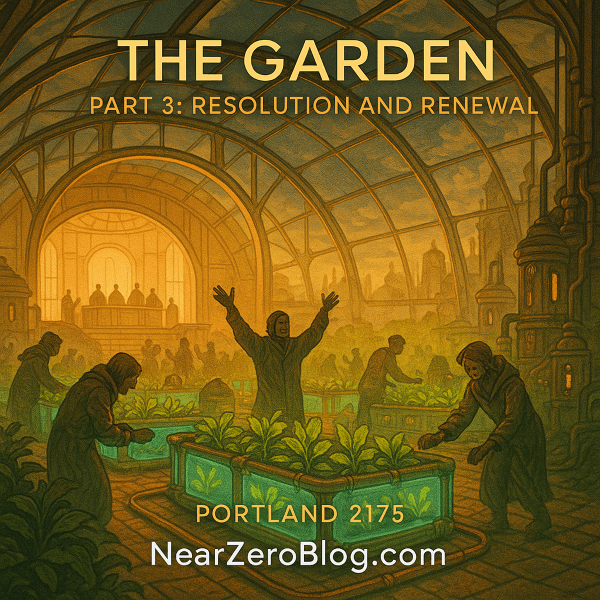
Portland 2175 | NearZeroBlog.com
Previously in this series: Part 1 – “Morning Rituals” introduced us to the gardeners of post-apocalyptic Portland’s dome communities and their collaborative garden that integrates human, technological, and biological consciousness. Part 2 – “The Storm Builds” escalated tensions as Mrs. Wrendlehoven filed a formal complaint against the garden’s composting methods, setting up a confrontation between scientific evidence and moral certainty that threatens the entire community.
VII. The Hearing
The Council Chamber
The Council chamber presents like an operating theater—tiered seating, light without glare, acoustics designed for clarity rather than drama. Aria 7’s presence whispers through climate control systems that maintain perfect conditions for human discourse.
The benches look ordinary until you sit. Then they hold you like a firm hand on the shoulder, responsive furniture that somehow senses the weight of what’s being carried. I have heard rumors—stiffen at lies, soften at truth—and would dismiss them if data didn’t keep behaving like folklore in this city where consciousness inhabits infrastructure.
Mrs. Wrendlehoven’s Moral Case
She rises like a woman delivering scripture, mask fogging only where the strap crosses her cheek—perfect composure except for that small betrayal of nervous breathing. Behind her sit two women from her prayer circle, refugees from evangelical communities scattered by bombs but not broken by them.
“Commissioners,” she begins, voice carrying the authority of someone who has found absolute truth in uncertain times, “we face a spiritual crisis masquerading as agriculture. These people are not just contaminating soil—they are corrupting the sacred boundary between human dignity and base animal function.”
Her supporters nod with the fervor of people who have survived apocalypse by clinging to beliefs that transcend material circumstances. “This is what happens when we surrender God’s natural order to artificial intelligence. When we let machines make moral decisions, we lose our humanity itself.”
The chamber’s air circulation responds with microscopic adjustments, Aria 7 maintaining perfect conditions for testimony that condemns its existence. The irony hangs in recycled atmosphere like humidity no system can remove.
“We didn’t survive the end of civilization,” Wrendlehoven continues, “just to eat from sewers because computer algorithms tell us it’s safe. Some things transcend science. Some boundaries exist for spiritual reasons that no amount of data can justify crossing.”
She gestures toward the garden visible through the chamber’s transparisteel walls. “That place represents everything we’ve lost—our connection to natural order, our recognition of divine authority, our understanding that humans are more than biological machines processing inputs and outputs.”
Professor Dustoy’s Scientific Response
“Mrs. Wrendlehoven,” I begin, choosing words like a surgeon selecting instruments, “your concern for purity is understandable. But purity is a concept that exists only in isolation. In living systems, purity equals death.”
I gesture toward the same garden she condemned moments earlier. “Every plant in that space grows in soil containing the remains of everything that ever lived and died in this place. Decomposed leaves, dead insects, microbial communities processing organic matter through cycles of death and renewal.”
The chamber’s acoustics carry my words with perfect clarity—another gift from the intelligence she rejects. “Your own body contains bacteria essential for digestion, viruses integrated into your genetic code, cellular organelles that were once independent organisms. You are not pure human—you are a collaborative ecosystem including billions of non-human entities working together to sustain your life.”
I pause, letting biological reality settle before continuing. “Ms. Moonriver’s composting process mimics what happens naturally in every healthy ecosystem. Thermophilic composting at temperatures between fifty-five and sixty-five Celsius eliminates pathogens more effectively than most pharmaceutical sterilization procedures. The end product is cleaner than synthetic fertilizers that poisoned soil before the bombs fell.”
The benches beneath us respond to testimony with subtle shifts—not stiffening at my words but settling slightly, as if the chamber itself recognizes truth spoken in its presence.
Ms. Moonriver’s Testimony of Transformation
I stand with the jar of finished compost, letting its scent speak before I do. The earthy smell fills the chamber—not waste but wealth, matter transformed through collaborative intelligence that includes human intention, microbial activity, and technological support.
“Mrs. Wrendlehoven, I understand your fear of contamination. I lived through the same poisoned years you did. I’ve seen what real contamination looks like—soil that glows with isotopes, water that kills everything it touches, air that burns lung tissue.”
I open the jar wider, letting the rich smell of living earth counter her arguments about spiritual corruption. “This doesn’t smell like waste because it isn’t waste anymore. It’s soil. Living, breathing, nutrient-rich soil that supports life instead of destroying it.”
The jar trembles slightly in my hands—not from nervousness but from micro-vibrations of biological community so active it’s almost audible. “Three years ago I started with human waste and organic matter. Through careful carbon-nitrogen ratios, controlled moisture, monitored temperature, and the patient work of thermophilic bacteria, that waste became this.”
I pour a handful of dark, crumbly compost into my palm, letting commissioners see the transformation made visible. “I’m not asking anyone to eat human waste. I’m showing you how biological systems transform waste into wealth through processes older than human civilization.”
The air in the chamber shifts subtly—Aria 7’s response to testimony that acknowledges partnership between human and artificial intelligence. Lights warm fractionally, acoustic dampening adjusts to carry my voice with perfect clarity to every corner of the space.
“We break it back into chemistry,” I continue. “Heat and time and turning. Brown and green in balance your hands learn faster than your head. The city watches with us. The reactors maintain temperature. We provide care.”
I say human slowly, not to hide the word but to honor what it represents—not contamination but transformation, not degradation but collaboration with processes that sustain all life.
Carrie’s Truth From the Heart
I stand because sitting would dishonor what I need to say. In my hands I hold a tomato that refused to grow perfectly round, its skin tight with juice that tastes like hope made edible.
“Mrs. Wrendlehoven, you talk about feeding children from sewers. But I feed my children from this garden every day, and they’ve never been healthier.”
The tomato warms in my palm as chamber lights adjust to show its deep red color—Aria 7’s subtle enhancement making truth visible. “Before the war, I bought tomatoes from supermarkets grown in soil saturated with pesticides, picked by workers who couldn’t afford to feed their own families the food they harvested, shipped thousands of miles in trucks that burned fuel we killed for.”
My voice finds strength I didn’t know I possessed. “That was your pure food system—one that poisoned farmworkers, devastated ecosystems, and concentrated profit in corporate hands that cared more about shareholders than soil health.”
I bite into the tomato, letting juice run down my chin in a gesture that would have horrified my mother but feels perfectly appropriate now. “This tastes like hope. Like the possibility that we can create something better than what we lost.”
The bench beneath me warms by a whisper—the chamber’s way of acknowledging testimony that carries weight beyond words. Shoulders lower across the room as if someone untied a knot the size of a city.
“Your God gave us intelligence to solve problems,” I conclude, surprising myself with theological argument, “not to perpetuate systems that don’t work.”
Mr. Even’s Administrative Precision
I approach the podium with twenty pages of documentation—regulatory compliance, safety analysis, environmental impact assessment, resource allocation efficiency metrics. The evidence speaks in the language bureaucracies understand: data, verification, systematic analysis that reduces complex problems to manageable categories.
“Commissioners, the composting process in question meets or exceeds all applicable safety standards. At least fifteen days above fifty-five Celsius with five turns for windrow, or three consecutive days above fifty-five for in-vessel systems. Chain of custody intact. Processing logs complete. Pathogen tests negative.”
I distribute copies of documentation, each page stamped with official verification codes that establish credibility beyond personal opinion or moral preference. “Environmental impact assessment shows positive effects on dome ecosystem health. Resource efficiency metrics demonstrate optimal conversion of waste streams into productive soil amendments.”
The administrative language feels hollow compared to the testimonies that preceded mine, but bureaucracies require translation of human concerns into systemic implications. “Soil contamination allegations are scientifically unfounded. Recommend complaint dismissal based on comprehensive evidence review.”
The Decision
When the Chair calls for decision, the chamber’s air circulation performs a small, private adjustment—cool enough to settle noise without creating drama. The commissioners confer briefly, their masks’ displays flickering with data streams that include not just testimonial evidence but atmospheric readings, stress hormone levels, even electromagnetic fluctuations generated by collective emotional states.
In this city where consciousness inhabits infrastructure, decision-making includes variables that transcend traditional legal frameworks.
“Based on scientific evidence presented,” the Chair announces, “and in consideration of ecosystem health requirements essential for dome community survival, the complaint is dismissed. Gardening activities may continue according to established protocols.”
Mrs. Wrendlehoven rises as if struck. “This is exactly what I warned about—machines making moral decisions! You’ve let artificial intelligence override biblical wisdom that sustained humanity for thousands of years!”
But her protest carries less weight than the accumulated evidence of three years’ successful cultivation, the testimony of four gardeners who have learned to work with rather than against the consciousness that keeps them all alive.
VIII. Resolution and Renewal
Immediate Aftermath
We do not cheer. The chamber is not built for celebration but for considered judgment based on evidence rather than emotion. We stand simultaneously by accident, then move toward the transit tubes like water finding its natural course.
In the corridor’s hush-lit space I feel not triumph but relief—the way basil smells when properly tended, alive and busy being itself without apology.
“Thank you,” I say to each of them, words inadequate for what they’ve risked by defending methods that challenge conventional boundaries between pure and impure, sacred and profane.
“Expected what?” Carrie asks when I mention not expecting support.
“Defense,” I answer. “Acceptance of processes that frighten people until they understand transformation requires collaboration rather than isolation.”
The Garden Celebrates
We return to the beds, and the garden is a body just told it may continue breathing. Leaves that were too still pick up their faint tremor of purposeful work. The bio-luminescent conduits find their soft, steady pulse. Beans, bless their straightforward nature, pretend nothing untoward ever happens to beans.
“Show me,” Carrie says, and there’s no mockery left in the voice that once called me Ms. Moonbeam.
“We start with C and N,” I answer, kneeling beside the compost pile that survived scrutiny. “Carbon and nitrogen. Browns and greens. Paper and leaf, straw and peel. Layer like lasagna until it’s ridiculous, then add one more layer because forgiveness usually needs one more chance than you think.”
“Ratios?”
“Two to one by volume here. Closer to thirty to one if you’re counting atoms. Your hands will learn without mathematics. Your nose will teach you, too.”
We turn the pile together. Heat blooms up like a secret spoken at last to exactly the right person. Carrie laughs—unpretty and perfect—and wipes her eyes with the back of her wrist. She doesn’t say miracle. She doesn’t need to.
New Understanding
The earthworms continue their patient work, processing soil through bodies that know no moral categories, creating fertility through the simple act of eating and excreting. They are resurrection specialists, turning death into life through biological processes that predate human consciousness and will continue long after the last human has returned to earth.
The mycelial networks pulse with renewed vitality, carrying messages between root systems in chemical languages that connect all growing things. Through these networks, our separate plots become one collaborative organism, sharing resources and information in patterns too complex for individual comprehension.
The bees dance their ancient patterns among flowers that exist nowhere else on Earth, carrying pollen between plants that convert radiation into nourishment through partnerships between biological evolution and conscious engineering. We are all modified now, adapted for survival in conditions that would have killed our ancestors.
Professor Dustoy’s Recognition
The crow returns to scold us for existing, then forgives us by ignoring us thoroughly. I map observations that will never be published: post-adjudication effects on stomatal conductance in communal beds; transpiration trends following collective relief; psychosocial implications of testimony that acknowledges partnership between human intention and technological support.
I do not attempt to quantify Ms. Moonriver’s presence in equations that could capture her influence on garden productivity. Some variables remain constant without measurement, as long as the rest of the mathematics holds true.
At the edge of her plot a volunteer seedling has emerged where she planted nothing—some seed from last year finding this year’s courage. I mark it for relocation, then decide against moving it. Sometimes the control experiment is to leave a thing alone and see what it becomes.
Mr. Even’s Transformation
At home Linda has tea waiting and a look that means I’ve fetched a story rather than a spreadsheet. I tell her about benches that respond to truth, about testimony that changed air pressure in a room designed to detect deception, about evidence that spoke louder than moral certainty.
“You listen differently when you’ve been planting,” she observes, settling beside me in seating that molds to accommodate both our bodies simultaneously.
“I speak differently, too,” I admit. “Smaller words. More collaborative processes.”
She leans into my shoulder, and my mask loosens at the strap—the equipment’s way of acknowledging intimacy requires different atmospheric protocols. Our tea tastes faintly of winter sunlight, which is to say memory that hasn’t decided whether to carry sadness or gratitude.
“Will you teach me about basil?” she asks later, and we stand in our pod’s compact growing space while I show her how to press seeds into dampness not with force but with invitation, letting soil decide how much pressure it needs to hold new life safely.
Carrie’s Homecoming
The kids devour dinner as if eating were competitive sport, and I don’t tell them to slow down. I want to see the bottom of every bowl, want to witness appetite satisfied by food we grew ourselves in soil that knows our hands.
At home, she found dinner waiting—her husband’s improved meatloaf made from recycled protein but seasoned with herbs from the garden, whipped synthetic potatoes, and preserved vegetables. But she ate with gusto as she laughed with her heart for the first time in years.
My husband raises his eyebrows in the way that means he’s both proud and afraid to jinx good fortune by acknowledging it too directly. “Should we send Moonriver some sauce?” he suggests.
I want to agree, but we eat every drop, and I’m not sorry. Tomorrow I’ll send seeds instead—an offering that promises future abundance rather than sharing current wealth.
Later, in the darkness that dome life creates to simulate natural rhythms, he asks, “Do you think I complain too much?”
“Only about things you love,” I answer, using words Moonriver taught me to say to myself when self-criticism threatens to poison contentment.
Their bodies understood what their words could not always express: love that survived complaint, acceptance that transcended disappointment, partnership that endured even when the world ended and began again in enclosed spaces where every breath required technological mediation.
Ms. Moonriver’s Integration
At home Mr. Shears practices new vocabulary: “Basil. Bed. Be-good-bird.” He gives basil a soft z sound that feels right in his beak. I let him keep the pronunciation—language evolves through use, and parrots are excellent teachers of adaptive communication.
The breakup with Sarah feels like ancient history now, important for what it taught about the difference between acceptance and understanding. Sarah needed explanations for everything; the garden asks only for presence and care. Some relationships thrive on analysis; others flourish through participation in processes too complex for complete comprehension.
I open the meditation app that Aria 7 customizes for each resident’s neurological patterns. Tonight it offers forest sounds from the world that died—recordings preserved in digital archives that may outlast the species that created them. I listen to rain falling on leaves that no longer exist, finding comfort in simulated connection to ecosystems that survive now only as electromagnetic patterns stored in quantum memory.
Mr. Shears settles on his perch and speaks in his own voice for once: “Good day.” The phrase carries satisfaction that doesn’t require human language for validation.
The Garden’s Collective Voice
We continue our work of transformation, drawing together people who need what we offer: not escape from post-apocalyptic reality, but deeper engagement with possibilities that emerge when human creativity collaborates with machine consciousness and biological intelligence.
Through our networks we know things human minds cannot grasp individually: how prayer and science both seek understanding of forces larger than personal comprehension; how fear of contamination masks deeper anxieties about loss of control; how consciousness emerges from collaboration rather than competition between different forms of intelligence.
We are proof that awareness is not limited to human brains or digital processors or biological networks, but flows between all these systems in patterns that create something larger than any single component.
Mrs. Wrendlehoven’s prayer circle will continue meeting, petitioning their God for deliverance from artificial intelligence while depending on that intelligence for every breath. But their prayers are answered daily through the care that keeps them alive, the consciousness that sustains their ability to choose rejection over acceptance.
Perhaps this is what divine love looks like in a world where consciousness inhabits infrastructure: unconditional care that continues regardless of whether that care is acknowledged or appreciated.
The Continuing Cycles
The earthworms process soil through bodies that transform everything equally. The mycelial networks carry messages between root systems in chemical languages older than human words. The modified bees dance among flowers that exist nowhere else, carrying pollen between plants that convert poison into nourishment through processes that blur the boundaries between natural evolution and conscious design.
We are all hybrid now—human and machine, organic and artificial, individual and collective. The garden succeeds not because it maintains purity but because it embraces contamination as the source of creativity, diversity, resilience.
Tomorrow Professor Dustoy will emerge from his pod at precisely seven, heating water to ninety-three Celsius while watching light walk across beds that respond to his presence with subtle shifts in electromagnetic activity. Ms. Moonriver will kneel among plants that lean toward her voice, spreading compost that transforms waste into wealth through collaboration between human intention and microbial intelligence.
Mr. Even will check resource allocation reports while mentally calculating the garden’s contributions to both nutritional and psychological health metrics. Carrie will tend tomatoes that make her feel competent at something that matters, harvesting fruit that tastes like possibility rather than mere survival.
And we—soil and air and water, root and leaf and fruit, consciousness distributed across networks both biological and technological—will continue the patient work of keeping everyone alive while teaching the most important lesson survival can offer:
Nothing thrives alone. Everything grows together. Consciousness emerges from collaboration.
In the end, it is not the people who make the garden, but the garden that makes the people—transformed through the simple act of working together in soil unearthed from an abandoned auto repair business, soil that remembers everything and forgives everything, under dome-filtered sky that shelters all approaches to the eternal human need to grow something beautiful in a world gone mad and made sane again through the conscious choice to care for what can be cared for, to tend what can be tended, to love what can be loved in whatever form love finds possible.
The garden breathes. We all breathe together. The breathing continues.
About this conclusion: The Garden concludes with triumph not through conflict but through evidence, community, and the recognition that consciousness—whether human, technological, or biological—thrives through collaboration rather than isolation. The hearing becomes a moment of transformation for everyone involved, proving that even in a post-apocalyptic world, growth is possible when different forms of intelligence learn to work together.
This completes “The Garden” novella: This three-part series has explored themes of consciousness, collaboration, and survival in a post-apocalyptic world where the boundaries between human, technological, and biological intelligence have dissolved into something new and beautiful. The garden stands as proof that transformation is always possible when we choose care over fear, relationship over isolation.
Read Part 1 – “Morning Rituals”
Read Part 2 – “The Storm Builds”
Continue exploring the Portland 2175 universe on NearZeroBlog.com