
What She Said Was Blue
1,838 words. Reading time 8 minutes.
Tinny Finch returned to his mother’s house in late autumn, when the light was already thinning by midafternoon. The rooms smelled of old wood and talcum, as if time itself had given up polishing the place. Dust lay across the furniture like a skin, the curtains hung tired and half-faded, and the air carried the weight of something unspoken.
He had come to sort through her belongings—papers, photographs, the brittle detritus of a life. The task felt less like housekeeping than like archaeology: digging through layers of sediment where memory and resentment had hardened together.
In the top drawer of her writing desk, under a stack of receipts and brittle church bulletins, he found the envelope. His name was written across it in her delicate, slanted hand: My Son.
Tinny sat down at the desk. For a long moment he turned the envelope over, running his thumb across the glue-flap as if it might open on its own. He braced himself—not for sentiment, but for reproach. His mother, even in life, had never written a word without an edge.
When he tore it open, the letter inside was four pages long, written in her steady cursive. The ink had held its color, as though her disapproval had preserved it.
“It was the day everything was blue,” she began. “The sky, the girl’s dress, even the teacups I set on the table. I thought it was a sign from the Lord, an answer to prayer. You were nineteen, and I introduced you to her—Margaret, the minister’s daughter. I thought she was everything a good wife should be: polite, devout, ready for children. She would have lifted you up to the place where a man belongs, in the church and in the family. But you wouldn’t even look at her.”
Tinny remembered nothing at first. He read on, eyes skimming the words as if they belonged to someone else.
“You stared at your plate, sulking like a child. I was humiliated before the minister’s wife. Margaret was embarrassed too, though she said nothing. I knew then I could never trust you to do right by me or by God. You disappointed me that day more than I can say. From that day forward, you stopped being the son I prayed for. To tell the truth, I don’t care whether I see you again after I die.”
The words trembled in his hands. A day he had long forgotten—a minor awkwardness, a trivial afternoon—had festered in her memory as a verdict, a curse. For her it was decisive; for him it had been nothing. And yet, he realized now, it was about then that her attitude toward him had changed.
He set the letter down and pressed his palms against his temples. Slowly, as if coaxed from a darkened room, the memory began to stir. A summer afternoon, yes. A table set with tea and lemon cakes. A girl in a pale dress—blue, as his mother had written. He remembered her face only in fragments: a neat braid, a polite half-smile, a voice too soft to carry.
And he remembered himself, nineteen and restless, unwilling to play the role laid out for him. He hadn’t spoken rudely; he had hardly spoken at all. He disliked the girl at once, though for no particular reason. It wasn’t her fault. It was the situation, the suffocating expectation radiating from his mother’s eyes. He wanted nothing to do with it. He had wanted, in fact, nothing more than to escape the room.
For him, the incident had been an awkward half-hour, gone from memory the next day. For his mother, it had been a revelation, a fracture that split the course of their bond.
After that day, he realized, something had hardened in her. She was still cordial, yes, but the warmth had vanished. No more quiet confidences, no more easy laughter in the kitchen. Instead, there crept in the sly remarks, the insinuations. She decided then that he must be hiding something, that his refusal was not about the girl but about women altogether. She never said it outright, but the mockery came in barbs and innuendo. So particular, aren’t you? So careful with your clothes, your hair. Such a shame you’ve never taken to the ladies.
Tinny was not gay. He had simply found little to admire in the parade of romantic games that preoccupied his peers. The endless swapping of partners, the musical chairs of affection, seemed to him a farce. The prize was never love but ownership, manipulation—women like his mother, whose power lay in innuendo and emotional leverage. He wanted no part of it.
But his refusal, his resistance, became her certainty. And from that certainty, her scorn.
Tinny leaned back in the chair, the letter limp in his hand, and thought of the years that had stretched between that summer afternoon and now. His life had not been dramatic—no great loves, no children, no vocation that demanded a title. He had worked, he had read, he had kept to himself.
He knew, without bitterness, that he was not built for admiration. A fireplug of a body, bald before twenty-five, a face that seemed unfinished without a chin, and legs like sticks that barely held him upright. His mother had looked at him with pity that turned into disdain, as though his very form confirmed the failure she suspected in his soul.
Women had never been an answer for him. He saw how they cast aside partners as if changing seats in some social game, shifting from one to another in search of a better vantage, a richer prize. He found no prize at all, only quarrels and compromises, only a lifetime of negotiation that always seemed to tilt in the woman’s favor. His mother had taught him that much: affection could be turned to ridicule in a breath, a bond into a leash. He wanted no part of it.
His refusal, though, was read by others as deficiency. To his mother, it was proof of deviance; to others, it marked him as strange, a man unmoored from the rituals that gave society its pattern. She needled him with innuendos, always with that mocking smile: Of course Tinny isn’t the marrying kind.
Her religion made the gulf wider. She had prayed for him to be a minister, or at least a believer. He had rejected both—politely at first, then firmly. God was, to him, no more real than the promises women made to themselves. His disbelief sealed him, in her mind, as a double failure: faithless in love, faithless in God.
And so he lived with her contempt. Not openly expressed, but always there, a background hum that accompanied him through the decades. When he thought of it, he sometimes heard lines of T.S. Eliot whispering back:
Do I dare to eat a peach?
The women come and go, talking of Michelangelo.
Good night, sweet ladies.
Those fragments became his liturgy. They gave shape to the life he had chosen—no less lonely for being deliberate, no less judged for being his own.
Poetry had been Tinny’s companion in ways people could not. The verses were not consolations exactly, but mirrors tilted at an angle, showing him what could not be faced head-on. He carried Eliot’s lines in his mind like a set of private refrains. They clung to him as armor. They were not memories, but counter-memories, substitutes for the stories others expected him to tell. When women asked why he never married, he thought of Eliot’s drawing rooms filled with chatter. When his mother asked if he was afraid of intimacy, he thought of the peach, ripening into ridicule at the touch.
Poetry did not redeem his solitude, but it gave it cadence. It taught him that life could be endured as rhythm if not as narrative. If his mother had written her judgment into scripture, then Eliot gave him a psalm of resistance, a language where failure might still rhyme.
Now, holding her letter, he saw how their memories clashed: her “day of blue” against his near-blankness, her humiliation against his indifference, her lifelong wound against his forgetfulness. Each had written the event differently, but only hers had survived until now, solidified in ink.
His version had to be coaxed back, fragmentary, more like a poem than a recollection. He realized, with a chill, that memory was not a return but a composition—each of them authors of a story that could never meet.
The letter lay flat on the desk, her words crowding the page as if they wanted to overtake his silence. Tinny read them again, slower this time, not for their content but for their weight. Everything was blue. You wouldn’t even look at her. From that day you stopped being the son I prayed for.
He closed his eyes. What he remembered was not blue but gray—a dim impression of boredom, of wishing he were elsewhere. He remembered the drumming of his fingers against his thigh, the stale taste of the tea, the way his mother’s sentences seemed rehearsed, already charged with expectation.
For her, the day was revelation: a hinge upon which their whole bond swung closed. For him, it had been a half-forgotten afternoon, inconsequential until she enshrined it as decisive. They had not remembered the same event; they had each authored it anew.
It struck him then that memory was less a mirror than a fracture. Each shard reflected a different angle, each cut a different shape, and no two pieces could be joined without leaving seams. His mother’s memory condemned, his own dismissed. Between them yawned a gap where the “truth” should have been but never was.
Perhaps memory was not meant to be faithful at all. Perhaps it was meant only to console, or to wound. A story to live by, not a record to consult.
He looked again at her last line—I don’t care whether I see you again after I die—and felt the crack widen. This was not recollection; this was judgment, sharpened into permanence. And yet, even as he recoiled, he knew he was already rewriting her words, weaving them into his own rhythm, softening them by comparison to the silence that followed.
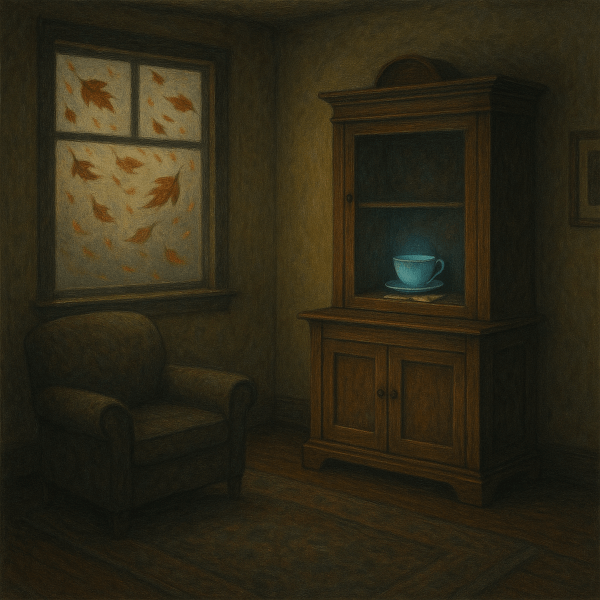
He folded the letter back into its envelope. For a moment he considered saving it, locking it away like a relic. But instead he walked to the cabinet in the living room, pulled open the glass door, and slid the envelope beneath a blue porcelain teacup. The paper lay there in the dimness, pressed by porcelain, hidden in plain sight.
He stood for a long while in the doorway between the rooms. Outside, the wind rose suddenly, swirling a scatter of brittle leaves across the yard. The season had chosen its color, not blue, not gray, but the restless rust of autumn.
He turned off the lamps and left the house to its silence.