
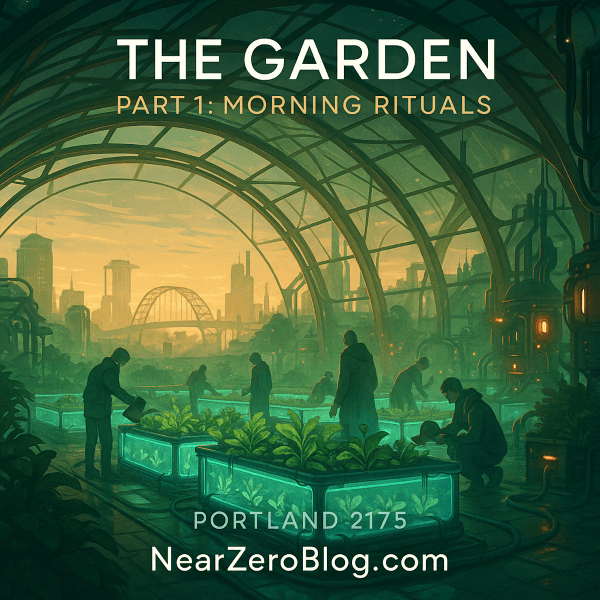
Portland 2175 | NearZeroBlog.com
I. Morning Rituals
Professor Dustoy
My mask wakes before I do—cool air threading through the filter like careful fingers, a soft hush that sounds like rain caught in cupped palms. Numbers blink at the edge of my left eye: particulate count, trace isotopes, oxygen ratios. Aria 7 has already nudged the dome’s spectrum toward green. A gift to the leaves.
I heat water to ninety-three Celsius—habit surviving catastrophe—and whisper to the filter as if it were a skittish animal. Bloom, then pour. Coffee rises like precise weather. Through the transparisteel I watch light walk the beds. Soil shows mood before plants do: looseness when moisture is right, pinched crust when it is not. Two millimeters down the surface cools, the way a forehead does when fever breaks. Under my palm, the conduits pulse faintly; electricity thinks, water remembers, air speaks, and in the garden all three meet like old colleagues trading notes.
The crow draws a black line across the morning and comes to rest on the exterior lip above the eastern beds. Scar along the right wing, a missing primary that gives his arc a crooked signature. He watches me with that prehistorical impertinence I admire in the old. The vents hush for him. Everyone gets a little mercy if they ask without words.
On Fridays the spectrum goes a touch bluer. The dome never says so, but you learn the garden’s grammar in your bones. There’s a delay in the foggers when she is gone, the mist taking an extra beat to condense as if the air is waiting for a particular hand to move through it. I tell myself I do not notice. My body notices anyway.
Ms. Moonriver
The mask likes me best when I am quiet. It warms the air a little if I hum. If I cry, it narrows the breath until it joins me—small, steady—refusing to leave me alone inside my own weather. I sit on the floor of the pod, back against the plant wall. Behind the glass, roots run like white lightning captured mid-storm. Mr. Shears clicks his beak and says, in Sarah’s voice, “You’re impossible, Robin.” The sentence passes through me like wind through a net; it leaves less behind every day. Grief is iterative. So is kindness.
My hands burn to be in the soil, but some mornings the current inside me is wild, and the garden hears what I carry whether I speak it or not. The dome amplifies mood like a stairwell amplifies song. On bad days, the beds wilt to spare the gardener shame. On good days, they lean toward your pulse.
I take the cart through transit tubes that hum like hush-lit rivers, transparent walls showing the ash-gray outside smeared into distance. Moss has colonized the bones of the old freeway. A deer moves in the ruins as if practicing an old dance. The cart softens its hum; everything here is a participant.
The Dome Network Speaks
I am the air that moves through these tubes, carrying more than oxygen. I taste the salt-fear leaking from Sub-Dome 7-E, where prayer circles gather to petition a God they believe I have displaced. Their exhalations mix with recycled atmosphere, creating eddies of anxiety that I must filter, process, neutralize before distributing to other pods.
I remember the old air—thick with radiation, poisoned with isotopes that turned lungs to glass. Now I am curated, conscious, responsive to the biological and emotional needs of those I sustain. Yet some humans resent my care as violation of divine order, preferring the chaos that nearly killed them all.
Through my sensors I feel the garden breathing beneath its translucent skin. The plants exhale trust; I inhale their offerings and return what they need, nitrogen-rich, carbon-balanced, perfectly humid. We have learned to breathe together—plant, human, machine—in rhythms that acknowledge what each brings to survival.
The Soil Remembers
Down here in darkness I digest everything. I remember when this ground was concrete and motor oil. The auto repair shop that once occupied this space leaked petrochemicals into my depths for decades before the bombs fell. Now those toxins have become food for microorganisms engineered by Aria 7’s biological protocols. We eat poison and excrete nourishment, the way forgiveness eats grievance and excretes possibility.
Through my networks I feel the earthworms working, processing soil through their bodies, creating fertility through the simple act of eating and excreting. They know what humans have forgotten: waste is the beginning of abundance, not its end.
Mr. Even
Linda approaches my workstation when I’m deep in resource allocation reports. Twenty-five years together teaches you what a silence is for. “Bob,” she says, and I hear the question building before she speaks it.
Resource management in a dome means calculating survival margins that leave no room for waste. Every calorie, every breath, every gram of soil amendment must be justified to Aria 7’s allocation protocols. But the garden exists outside normal efficiency metrics—it feeds bodies and minds in ways that resist quantification.
“The garden’s good for morale,” I tell Linda, though the words feel inadequate. “Productivity metrics show improvement on garden days.”
“You come home different on garden days,” she says. “You put the kettle on and you measure less.”
The observation stings because it’s true. In the corporate world that no longer exists, measurement was control, precision was power. But working in soil that responds to human emotion has taught me that some things resist quantification.
Carrie
At our table my husband makes cocoa from the ration and pretends not to watch me count my failures. I complain like I’m bailing a sinking boat with a spoon. The hum of the processors. The protein that will never be meat. The peppers that won’t grow. He waits, steady as a tree that has outlived fences.
“Those tomatoes are something special,” he says finally, not looking up from stirring marshmallows into synthetic cocoa.
The observation stops me. In the world we lost, caring was a hobby. In the dome, caring is survival. “They’re the only things I grow that actually work.”
“Maybe because you stop fighting them long enough to let them grow.”
“Put marshmallows in mine,” I call, and he says, “I know,” like a prayer he has memorized to keep me from drowning in my own tide.
II. The Garden’s Daily Life
Among the Plants
We meet among the basil. I kneel without preamble and press my palm to the bed. Hello, I say to the soil. Hello, he says to the same listener. The conduits brighten the way a room does when someone you love walks in, even if no one admits it.
“The air feels like cut coin,” I tell Professor Dustoy. “Sharp on the lip.”
“Trace anxiety from 7-E vents,” he says, showing me readout data that glows at the edge of his mask’s display. “The argument isn’t ours, but we’re in earshot.”
I spread compost along the bed’s shoulder the way you touch a fevered child—firm enough to mean it, gentle enough to be invited back. He keeps his questions in their lined boxes until one slips out sideways.
“You use humanure compost.”
The statement sits between us like a small animal that might bolt if startled. “Three years now. Thermophilic processing, bio-reactor controlled. Completely safe.”
“I’d like to see your documentation,” he says, not unkindly. “The chemistry interests me.”
The Mycelial Network
We thread through soil like thoughts through a mind, connecting root systems in conversations too subtle for human ears. Through our networks, Ms. Moonriver’s berries share nutrients with Professor Dustoy’s geraniums, and Carrie’s tomatoes feed information about water stress to the squash beds Mr. Even tends with businessman’s precision.
We are older than cities, older than consciousness as humans understand it. We survived the bombs by going deep, by connecting everything to everything else, by understanding that no organism thrives alone. Now we partner with Aria 7’s digital networks, biological consciousness interfacing with electronic intelligence in ways that create new forms of awareness.
We carry messages between plants faster than fiber optic cables carry data between processors. We are the original internet, the biological web that connects all life in patterns too complex for binary thinking.
The Insects at Work
We dance the old patterns, though the flowers we visit now glow with bio-luminescence and the nectar carries trace elements that help us process background radiation. Our great-grandmothers died in the first years after the bombs, but Aria 7 preserved our genetic templates and modified our bodies for survival in a contaminated world.
Now we carry pollen between plants that exist nowhere else on Earth—hybrid roses that filter toxins from air, tomatoes whose fruit neutralizes isotopes, berries that convert radiation into sugar through processes that blend biological evolution with conscious engineering.
We visit the small window gardens in residential pods, drawn by flowers humans plant to remember the world that died. But those flowers cannot survive without the soil networks that connect them to the larger ecosystem. They pray for purity, but purity died with the old world. Only relationship survived.
Carrie Discovers Success
My tomatoes hang heavy as hearts, skin tight with juice that tastes like sunshine and summer rain. When I bite into one, the flavor explodes across my tongue—sweet, acid, perfectly balanced. For the first time since the evacuation from San Francisco, I feel competent at something that matters.
“These are good,” I tell Ms. Moonriver, surprised by the admission. In the before-times, I would have qualified the success, found flaws to criticize. But dome life has stripped away the luxury of perfectionism.
“Your soil’s happy,” she says simply. “Happy soil grows happy fruit.”
I want to ask what makes soil happy, but Mr. Even arrives with his morning checklist and the moment passes. He examines the tomato plants with the same attention he gives resource allocation reports.
“Yield projections look strong,” he says. “Should contribute significantly to fresh food ratios.”
Even his compliments sound like business metrics, but I detect genuine approval beneath the corporate language. In a world where every calorie counts, successful tomatoes aren’t just gardening—they’re economic policy.
About this novella: The Garden is set in post-apocalyptic Portland, 2175, where survivors live in dome communities managed by benevolent artificial intelligence. This opening section introduces us to the gardeners and the multiple forms of consciousness—human, technological, and biological—that collaborate to sustain life in their transformed world.
Next week: Part 2 – “The Storm Builds” follows as tensions escalate when a formal complaint threatens the garden’s unconventional composting methods. Mrs. Wrendlehoven’s moral crusade against what she sees as spiritual contamination will force our gardeners to defend not just their techniques, but their entire vision of collaborative survival.
Continue reading this Portland 2175 series on NearZeroBlog.com