
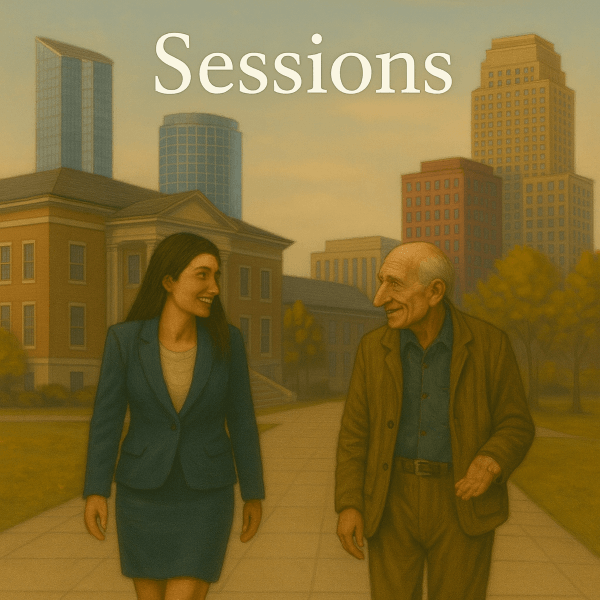
Sessions
2,771 words, 15 minutes read time.
Three months later, Dr. Limbini sat in her office, watching Lester arrange the morning’s data collection sheets with the same careful precision he’d once used stocking shelves. His hands moved differently now—still deliberate, but without the medication-induced restraint. More like Mickey Stanley going to where the ball would be.
“Got seventeen responses yesterday,” Lester said, not looking up from the papers. “Three people wearing yellow sat by the windows. All the blue people went toward the back. Like they wanted walls behind them.”
Dr. Limbini made a note. His insights were helping her collect the observational data that was proving invaluable to her research on environmental behavior patterns. Even the Dean of the Business School had inquired about her research, which could help develop new marketing and advertising tools.
“A woman in a red sweater. 50ish.” Lester continued, “She kept looking at the door. But she stayed two hours. Read three magazines. I think the red meant she wanted to be noticed and the door-watching meant she was waiting for someone.”
“What do you think the red meant to her?” Dr. Limbini asked.
Lester shrugged. “Maybe like wearing a good shirt to a job interview. You want them to see you, but you’re scared they will.” He looked up. “Not that different from what you do when you give those talks at the university. You dress nice but your hands shake a little.”
She smiled. He noticed everything. “How do you know my hands shake?”
“Same way I know when the stock room manager’s having a bad day by how he stacks the boxes. Bodies don’t lie. You always leave and come back nervous. I figure a person would have to be insane to not be nervous speaking in front of a crowd. Let alone having to argue with them.”
Dr. Limbini finished writing and set down her pen. In three months of working together, Lester had helped her collect data that would’ve taken a year to gather. But more than that, he’d taught her things about observation she’d never thought of.
“Dr. Pistik wants to meet with me next week,” she said. “About expanding the study.”
Lester’s hands stopped moving. “What’s he want?”
“To understand how you see patterns others miss. He wants me to hire more people like you.”
“More people like me?” Lester looked surprised. “There are more people like me?”
“People who watch things carefully. People who notice details.” She paused. “And the department wants to hire assistants to study those people while we conduct our research gathering. Create a team of observational researchers to assist in developing training methods.”
He was quiet for a moment, organizing the papers into neat stacks. “Somebody’s going to be watching me?”
“No. Not in the way you might be thinking. Just observing you while you observe others.”
“But why? How is this going to change things? My job, I mean.”
Dr. Limbini considered. “I came to the conclusion that my studies have to have their use if they are going to change systemic bias. The best way to do that is through collaboration with the system itself. I just want my work, my life, to have an actual impact on society. My research can help the University provide services to the community.”
“While making me a guinea pig.”
“No, Lester. No. To learn from you. We can’t teach the community to understand your intelligence unless we change their perception. Unfortunately, we need collaborative data to prove our analysis. That means we have to make arrangements with other departments to provide our services, and to allow them to study us and our methods.”
“I guess I can understand that. Just seems strange to suddenly be conceding to the system you want to change.”
“It is not in my nature to be a revolutionary. I just want to do my work. And I can’t change something I am not a part of. I hope you can understand.”
“I think you’re good at what you do,” he said simply. “And I think I’m good at helping you do it. I don’t see why we’d need to make it more complicated than that.”
She nodded. Her body began to shake. She closed her eyes, took a deep breath, and said, “I am happy you said that. I cannot offer you a position that has benefits. The department doesn’t have the budget for that. However, what I can do is ensure that you always have work to do. Believe me, we are starting to get more attention with our studies now. And since you work directly for me and the others who will be hired will come from a temp agency, you will be in charge of the quality of the data being collected. Do you think you can do that?
Lester looked up, surprised. “Do what?”
“What you’re already doing. Environmental observation. Data collection. Pattern recognition. And showing others how to record their observations.”
“I won’t be telling University graduate students what to do.”
“No. People like you. Ordinary people who need work and are screened to have exceptional observational skills, and who have no college background. Or little, at most. We will pay them well so there is competition for the position and they won’t want to lose the assignment if they get it. That is one way we can sort of weed out the slackers. I need you to watch them. Make sure they are collecting the data correctly.”
“He went back to arranging papers. “What’s it pay?”
“Enough to get off food stamps. Enough for dental work.”
Lester touched his cheek unconsciously. Missing teeth were part of how people saw him—or didn’t see him. “Might be nice to smile without covering my mouth.”
“There’s something else,” Dr. Limbini said. “I need you to come with me this afternoon to give a presentation on our study. Dr. Scruntin just wants us to assure the budget committee that our research merits the consideration that it is being given.”
Lester nodded. “Ok. That makes sense. You’re the one who knows how to talk to professors. I hope I don’t have to do much talking.”
“You won’t, Lester. You won’t. I will do the entire presentation. You will just have to make small talk with Dr. Scruntin and Dr. Pistik.”
Her gut felt the look on his face, then her forehead matched his furrow. “But don’t worry,” she said quickly. “They aren’t there to make you look foolish or treat you indecently. They just have a great deal of responsibility and cannot afford to make the kinds of mistakes, make the wrong alliances, say the wrong things, that the rest of us can. They just want the program to succeed. And that’s what you want, don’t you?” Her fingers tightened and extracted.
“Alright. Alright.” His hands spoke resignation.
“What would I do there?” He looked genuinely puzzled. “Stand around and watch a bunch of academics talk about watching people?”
Dr. Limbini laughed. “That’s fair.”
“Would you like me to make a report?” he said, laughing.
“You’re right. That would be valuable data.”
He was quiet again, thinking. “But tell them I’m just someone who pays attention. Don’t make it sound like more than it is.”
Dr. Limbini felt something shift in her chest. “You’re more than someone who pays attention, Lester.”
“I don’t have any special training. I just watch things.” He shrugged. “That’s useful to you, but it doesn’t make me something I’m not. And I want to keep my dignity,” he said, his brows quivering and his temples tightening.
Her abdomen tensed as she watched his face, and she felt it in her power to give him the respect his body was not used to receiving. Their energies met in the open. His yielded. Hers caressed with empathy.
“I will tell them I met you in the park one day and found out that you embodied my research, and that you could help prove some of my theories about municipal engagement with marginalized persons.”
“Hmm. That sounds nice. But what am I gonna say to Dr. Scruntin? Dr. Pistik?”
She shook her head. Lester could see the confident energy that was growing in her lately.
“Don’t think about it too much. All you’ll have to tell them is what you were saying to the river when I first saw you. They might ask you where you picked up the gestures you make with your hands.”
“What?”
“You don’t expect Psychology professors to not ask about the way you talk with your hands. They might wonder about the extra vocabulary it brings to your expression. Sort of like making up for lacking an advanced vocabulary. You have found a way to express what you lack the words for.”
“Nice way of saying I’m uneducated.”
“Oh, Lester. Stop it!”
“Alright. Alright. I made your cheeks red.”
“Yes you did! And my neck. And I’m sure my nostrils flared.”
“They did!”
Dr. Limbini watched him finish organizing the data sheets. Each category was perfectly aligned, each observation noted with the careful attention of someone who’d learned that details mattered—sometimes more than the people recording them realized.
“Lester,” she said, “can I ask you something personal?”
“Sure.”
“Do you ever think about what your life would’ve been like if someone had noticed your intelligence earlier?”
He considered this, his hands stilling on the papers. “Used to. But I don’t much anymore.”
“Why not?”
“Because this is what happened. And this is not bad.” He looked around the office—at the artwork, books she’d recommended he read, at the plants that made the space feel less like a hospital, at the window that showed the park where they’d first really talked.
“Besides,” he continued, “if things had been different, I might not have learned to pay attention the way I do. Might’ve been one of those people who talks a lot but doesn’t see anything.”
Dr. Limbini realized he was right. His intelligence hadn’t developed despite his circumstances—it had developed because of them. Forty years of being underestimated had taught him to watch everything, to find patterns others missed, to survive by becoming genuinely useful.
“The conference presentation,” she said. “Do you mind that I’ll be the one talking about your work?”
“Why would I mind? That’s your job.” He looked genuinely puzzled. “I collect the information. You figure out what it means and tell other people about it. That’s how it should work.”
“But it’s your intelligence that makes the observations possible.”
“And it’s your intelligence that makes them matter to anyone else. It’s your work. I’m just doing what you told me to.” Lester smiled.
Dr. Limbini gathered her own papers, watching him pack the data sheets into folders with the same care he’d once used arranging soup cans. Three months ago, he’d been a psychiatric patient with a difficult history. Now he was a valued research assistant whose insights were changing how her department understood human behavior.
“Lester,” she said, “what do you want people to understand about what we do here?”
He thought about it. “That watching is not the same as staring. Staring’s about you—what you want to see. Watching’s about them—what they’re actually doing.”
“And the difference matters?”
“Difference matters for everything. Like the difference between Mickey Stanley knowing where the ball’s going to be and just standing there hoping it comes to you.” He stood up, folders in hand. “Or the difference between playing music because you got something to say and playing music because someone told you that’s what music’s supposed to sound like.”
Dr. Limbini nodded. “Or the difference between treating symptoms and understanding experience.”
“Yeah. That too.”
They stood by the door for a moment. Three months of working together had created something neither of them had expected—a productive partnership based on complementary strengths.
“Well, why don’t you go get lunch and meet me back here by 2 O’Clock.
“Yeah. I’ll get a hot dog and sit by the bus stop. Should be interesting. People waiting for the bus act the same as in the library. But they act different if they arrive in their own car. I can usually tell the people who don’t use the bus often. Like their car broke down or something.”
“That’s exactly the kind of insight I am talking about. Just say that kind of thing to Dr. Pistik. That’s what he wants to hear.”
“Really?”
“Really.”
He grinned—the first completely unguarded smile she’d seen from him. “It’s just paying attention.”
“It’s paying attention well. There’s a difference.”
“Yeah,” he said, understanding. “There is.”
After he left, Dr. Limbini sat back down at her desk and pulled out her notebook. She wanted to record her thoughts about their conversation while they were fresh. But instead of writing about methodology or research implications, she found herself writing about recognition.
Three months ago, I thought I was helping Lester understand himself better. Instead, he’s taught me that understanding is not something you do to someone else—it’s something you do with their help. His way of seeing is not a symptom to be managed or a deficit to be overcome. It’s a form of intelligence that supports rather than competes with academic training.
The university wants to expand our study, but they don’t fully grasp what they’re expanding. They see Lester as an interesting research subject instead of just a skilled data collector. They want to study his observational methods rather than simply benefit from them.
But Lester understands exactly what his role is. He’s not confused about being an academic or a theorist. He’s a specialist whose expertise happens to be embodied rather than theoretical. And he’s taught me that embodied expertise is often more accurate than conceptual knowledge because it’s grounded in actual experience rather than abstract frameworks.
She paused, looking out the window toward the park where their working relationship had begun. A man was sitting on a bench, feeding pigeons. His movements were economical, purposeful—each handful of breadcrumbs scattered with the precision of someone who understood exactly what he was doing.
It reminded her of Lester.
Dr. Limbini closed her notebook and began preparing for her afternoon appointments. The department meeting scheduled for later that week would go well. Dr. Pistik and Dr. Scruntin would approve expanding the observational research program, and she’d be able to hire more people with Lester’s particular skills.
But they’d be working for her, gathering data that she would analyze and present. That was the natural division of labor, and everyone understood their role.
Next month, she would present their findings to a room full of professors. She would talk about phenomenological approaches to environmental psychology and demonstrate pattern recognition techniques that couldn’t be taught in graduate school but could be learned by anyone willing to watch the world carefully enough.
And while she was doing that, Lester would be at the bus station, notebook in hand, recording how people behaved when they were caught between destinations. He’d note which colors gravitated toward which seating areas, how long people maintained eye contact with strangers, whether anxiety showed up differently in people traveling by choice versus necessity.
Next week, she’d have a folder full of new observations that would give her work depth and specificity that purely theoretical research could never achieve.
That, Dr. Limbini realized, was exactly how it should work. Not because either of them was less capable, but because they were capable of different things. And when different capabilities supported each other, people could do their best work.
She smiled, thinking about Lester sitting at the bus station, watching people with the same careful attention he’d once brought to stocking shelves. He’d probably notice things that would change how she understood human behavior in transitional spaces.
Because sometimes the best research happened when you found someone whose way of seeing complemented your way of thinking.
The difference, as Lester would say, mattered for everything.
About “Sessions”
“Sessions” explores embodied intelligence and institutional recognition through eight scenes of philosophical collaboration between an isolated academic and a marginalized retail worker whose environmental wisdom challenges conventional assumptions about competence.
This novella demonstrates the Ontology of Lived Meaning in literary practice—showing how consciousness operates through embodied engagement rather than abstract mental processes. Each scene builds understanding through sustained attention to how authentic meaning emerges in particular situations.
Experience phenomenological literature that invites deep engagement with questions about authenticity, recognition, and social justice. Subscribe to receive the complete work and companion essays exploring the intersection of philosophy, literature, and social consciousness.
*This is the eighth and final installment of Sessions. The story will be available as an eBook in the near future. For a comprehensive literary analysis of Sessions, click here.