
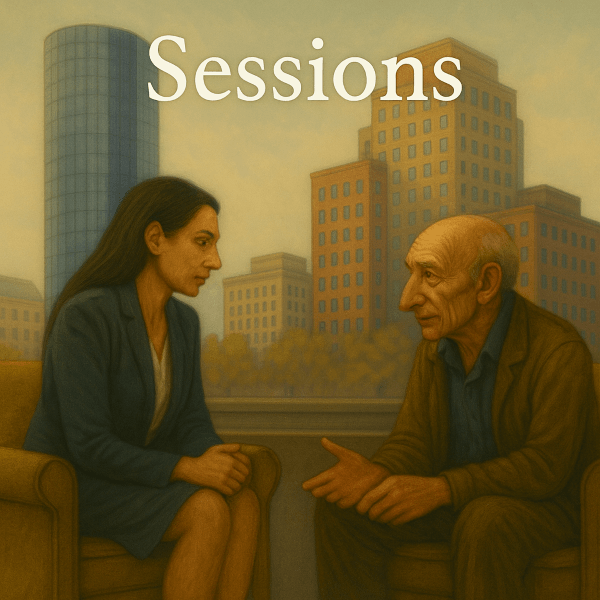
Sessions
Scene 7: Mutual Recognition
2,595 words, 14 minutes read time.
Dr. Limbini arrived at her office still processing the morning’s faculty development session on “Research Collaboration Standards.” The three-hour workshop had been a thinly veiled critique of her independent research methods, with particular emphasis on how “non-traditional partnerships” required additional oversight to ensure “methodological rigor.” Dr. Scruntin had made several pointed comments about researchers who “operate outside established departmental frameworks.” At the same time, Dr. Pistik had again suggested that her work might benefit from “senior guidance” to help her “contextualize unconventional findings.”
The department chair had pulled her aside afterward to express concerns about her decision to hire Lester as a research assistant. “Clemita, I understand your commitment to innovative approaches, but the tenure review committee will scrutinize any… unusual personnel decisions. You might want to consider how this reflects on your professional judgment.”
She’d spent the past week defending the hire to colleagues who questioned whether someone without formal credentials could contribute meaningfully to academic research. The assumption seemed to be that her decision was either romantically naive or professionally calculated—never that it was based on genuine recognition of Lester’s sophisticated intelligence.
Her parents had called the night before, their weekly check-in from Pittsburgh, including the usual concerns about her career choices. Her mother’s gentle but persistent questions about whether she was “building the right kind of professional relationships.” Her father’s suggestion that she might be “taking too many risks” with her research direction, that career advancement required “strategic partnerships” with established faculty. “You do realize that when this ‘homeless person’ doesn’t show up for work, you are going to look silly?”
Neither of them could understand that hiring Lester wasn’t a risk—it was the logical extension of everything her phenomenological research had revealed about embodied intelligence. The constant pressure to explain and justify her professional decisions was exhausting, especially when those decisions were producing exactly the insights her research aimed to capture.
Lester arrived at their seventh session looking more relaxed than she’d seen him since they began working together. Two weeks into his new job, something in his posture suggested he was finally working in an environment that valued rather than suppressed his intelligence.
“How’s the new job going?” she asked as he settled into his chair.
“Good. Real good.” His hands began their familiar movements, but with more ease than usual. “Been working on that observation project you set up. The one where I watch how people use the library study spaces.”
“What have you been noticing?”
“Lots of things. Like how most people come through the door without looking to their left. Like it is a given that there is nothing down there of interest. Nobody browses down that way. They browse in every place in the library but on the main floor to the left.”
“And we want to find out why they are doing that. That is the type of thing our research involves. The answer isn’t so simple. There are never any particular reasons for the body’s intuition. Reason is the mechanical tool that comes into play to explain our actions to ourselves and others. But our experience comes from our bodies. It is the vehicle through which we experience everything. “
Lester thought on in it, fretting his brows and wringing his hands. “Ok. It is science. I don’t know science. I thought I was just watching people and writing down what you tell me.”
“You are, Lester. You are. It’s just that the more you know about our research the more useful you can be. And that is why I asked you to help me do research. Because you showed me a natural understanding for the type of data I need to collect for my analysis. I don’t seek to explain some goal that we are constantly working towards, but the acts of the body, how it reads its environment. Like how you told me about learning from Mickey Stanley, how you saw different baseball players, confident with their surroundings, sort of owning their environment instead of doing what they are told. One of our projects involves understanding how the body does things intuitively. The types of movements various bodies do to perform the same task. How does the limitation of bodily movements affect the way we think? How does it affect our mood?”
“I guess I didn’t realize just how much your research involves when we were talking. I’m not educated, Dr. Limbini. Do I really belong here?”
“Yes! Oh, yes you do! I am sorry, Lester. I am just so excited about some of the research projects I am working on that I am trying to…” She looked at Lester and shook her head to herself, closed her eyes, and took a deep breath. “You are doing just fine, Lester. Do you understand the reports I want you to fill out for the work I want you to do this week?”
“Yeah. I think so.”
Dr. Limbini pushed against the nervous energy wrung from her body, her mind the tool telling another part of itself, ‘Shh, Shh, calm down, easy. Don’t hurt this poor man.’ She took a deep breath, hoping Lester wouldn’t be angry for asking, ” Can you show me?”
“Yeah. I check the right box on all of these questions,” He held up a thick pad. You want me to take a picture of the seat in the lobby at the hotel and watch people who sit in it and check the boxes on a new sheet on, uh, the top of the page every time they touch their face.”
“Correct. And in the space below, right here,” she said pointing to the area below the first box, “Check one of these boxes. What did they touch, their ear, their nose, mouth, cheek, scalp? Did they cross over and touch the right ear with the left hand? You answer all that in these boxes here. Do you understand?”
“Yes. Sure.”
“Ok. Let’s do a dry run. Say I am sitting down in the lobby.” She takes her left hand and crosses it over to the right side of the face and scratches her ear. “How do you fill out the boxes?”
Lester thought for a moment, and then, with a tentative shrug of the shoulders, filled in a sequence of boxes.
“Is that right?” he asked as Dr. Limbini looked over his shoulder.
“You got it! That is what I want you to do. You don’t have to do anything else.”
“Really? But what about the lighting, other people in the lobby, where they are sitting, what the weather is outside, the..?”
“Don’t worry about all that, Lester. I have a group of people working on the same project. Someone is gathering all of that information as part of their task. See, if I can break up the tasks so that each of you can focus on one thing, the integrity of the data isn’t compromised because there are a number of sources gathering data from the same environment and we can run controls. Anomalies aren’t eliminated; they are studied. …it’s…” She saw the blank look on Lester’s face. “Sorry, Lester. ” Then she laughed, not at Lester, but at how she must seem to him.
“Oh, hey. What about the seating selections at the library, did you get any data regarding that?”
“Well, there was one spot that a lot of people sit at, but not for long. No more than 20 minutes. It’s positioned so your back is to the main walkway,” Lester said with that slight nasal twang he had in his voice that gave him a Chicago-sounding accent. “People come up behind you without you knowing. Makes you feel exposed, like you gotta keep turning around to see what’s happening instead of focusing on your work.”
Dr. Limbini retrieved a file folder from her desk as she stood behind it. “Oh yes. Here it is.” She ran her finger down a page and flapped the page over to the next, quickly running her finger down the page. Did the same to a 3rd, 4th, and 5th. “Um hmm,” she said, ruminating. “I need to send Rachel and Dustin over there and see what each of them observes.”
“What else did you see, Lester?”
“People seemed to like spots where you can see approaching foot traffic, where you got a wall or something solid behind you, where you can watch the whole area without looking like you’re watching.” His hands showed the spatial relationships involved. “People want to feel like they can concentrate without having to stay alert for surprises.”
“That’s astute environmental analysis, Lester.”
“Just paying attention to what people actually do instead of what they’re supposed to do.” Lester’s expression showed satisfaction rather than pride. “Your colleagues been okay with me doing this kind of work?”
Dr. Limbini thought about the past week’s faculty interactions. “They’re… adjusting to the idea. Some of them question whether observational data without formal statistical analysis can contribute to rigorous research.”
“What’d you tell them?”
“I told them you’re documenting patterns that traditional research methods miss entirely. That phenomenological observation reveals aspects of human behavior that quantitative approaches can’t access.”
“That work out okay for you?”
“Dr. Scruntin suggested I might be ‘romanticizing alternative intelligence’ rather than conducting legitimate academic inquiry. Dr. Pistik recommended that I collaborate more closely with established faculty to ensure my research meets ‘institutional standards.’”
Lester was quiet for a moment, his attention moving between her face and his hands. “So they’re saying your way of doing research ain’t good enough unless you do it their way.”
“Essentially, yes. They want me to translate the insights I gather into traditional cognitive-behavioral language that loses exactly what makes them meaningful.”
“Same thing that happened at Minor’s. Follow the procedures whether they work or not, and if the procedures don’t work, that’s your fault for not following them right.”
Dr. Limbini felt the familiar recognition she’d grown to value in their conversations. “You understand institutional dynamics better than most people with advanced degrees,” She laughed.
“Just paying attention to patterns. Places that value compliance over competence, people who care more about following rules than getting good results.” He shifted in his chair, his expression becoming more serious. “But you’re taking a risk hiring me. Your colleagues aren’t gonna like you proving that their methods miss important stuff.”
“Maybe. But working with you teaches me more about embodied intelligence than years of academic literature. If that threatens my colleagues’ assumptions about legitimate research, maybe their assumptions need to be challenged.”
“You sure about that? Sounds like bucking the system could cost you.”
Dr. Limbini thought about the morning’s faculty session, about the constant pressure to conform to research methods that missed exactly what phenomenological investigation revealed. “Lester, I’ve spent my entire academic career trying to make my research acceptable to colleagues who don’t understand what I’m investigating. Maybe what I need isn’t their approval—maybe what I need is better demonstration of why their approaches are insufficient.”
“So you’re gonna keep doing what you know works, even if other people don’t get it?”
“I think both of us have learned something about maintaining authentic competence despite institutional pressure to conform.”
Lester nodded slowly. “Been thinking about that since I started working here. About how we both ended up in places where our kind of thinking gets recognized instead of pathologized.”
“What do you mean by ‘our kind of thinking’?”
“People who see what needs doing and want to do it, even if it isn’t exactly what the job description says. People who pay attention to what actually works instead of just following procedures. People who care more about getting things right than about looking like they’re doing things right. Who care more about what people need, that would make things better for them, instead of just simply what works.”
Dr. Limbini realized he was articulating something she’d been trying to get her parents to understand about her own academic situation. “Yes. You are certainly right about that.” Again, she laughed. I don’t think either one of us is going to let the system change who we are.” She looked at the older man and felt pity for what his body would endure as it aged. He already hobbled a little bit.
“Yeah. You hiring me, me accepting the job—we’re both saying that intelligence doesn’t have to look the way institutions expect it to look like. Are there other people like me? People whose competence developed outside traditional categories but who could still contribute in their old age?”
“Lester, there are millions of people like you. But most corporations don’t know how to recognize that kind of intelligence, so it goes to waste.” Lester’s hands showed a complicit relationship as he listened to Dr. Limbini. “Like at Minor’s. They had an employee who could read customer needs, anticipate problems, and improve efficiency. But corporate policies prevented them from using those skills. And in academic research, we have methodological requirements that prevent researchers from investigating forms of intelligence that don’t fit traditional categories.”
“So we both lucked out finding each other. You needed someone who could do the kind of observation your research requires, and I needed work that valued my observation skills instead of trying to suppress them. I can help you show that there are different ways to be smart, different ways to contribute, different ways to do good work.”
“That is what I am looking for, Lester. Maybe I can help create space for people whose competence doesn’t fit standard categories but who have insights that institutions need.”
Lester was quiet for several seconds, his hands showing the careful consideration he brought to important ideas. “You know what I been thinking about?”
“What?”
“All those people I worked with over the years. At Delmonico’s, at Minor’s, in the shelter system. Smart people, capable people, but stuck in situations that didn’t let them use what they knew.”
“Do you think some of them could benefit from the kind of opportunity you’ve found here?”
“Maybe. But it would take more people like you—people willing to look past credentials to see what someone actually knows how to do.”
Dr. Limbini thought about her colleagues, about the institutional resistance she’d encountered just in hiring one person whose intelligence developed outside traditional frameworks.
“That’s a much bigger change than either of us can create alone. Lester, I want to ask you something, and I want you to be completely honest.”
“Okay.”
“Do you think our meeting each other has been as valuable for you as it has been for me?”
Lester thought for a few seconds and said, “It’s valuable to me in that I may be able to afford to rent a nicer place to live and get my teeth fixed.” A big smile came to his face. The biggest smile she had seen on him. “And I get to work for someone who respects me as a person.”
Dr. Limbini laughed self-consciously. “Well, nobody disrespects you here, Lester.”
Walking Lester to the door, Dr. Limbini realized they’d moved far beyond the traditional therapeutic relationship she’d envisioned. They’d created a genuine bond in which both people brought expertise that enriched the other’s understanding.
The story wasn’t ending with either of them being “fixed” or “cured.” It was continuing with both of them more authentically positioned to do work that honored rather than suppressed their respective forms of intelligence.
About “Sessions”
“Sessions” explores embodied intelligence and institutional recognition through eight scenes of philosophical collaboration between an isolated academic and a marginalized retail worker whose environmental wisdom challenges conventional assumptions about competence.
This novella demonstrates the Ontology of Lived Meaning in literary practice—showing how consciousness operates through embodied engagement rather than abstract mental processes. Each scene builds understanding through sustained attention to how authentic meaning emerges in particular situations.
Experience phenomenological literature that invites deep engagement with questions about authenticity, recognition, and social justice. Subscribe to receive the complete work and companion essays exploring the intersection of philosophy, literature, and social consciousness.
Dr. Clemita Limbini encounters Lester on a park bench during her lunch walk—a moment that transforms both their understanding of intelligence, authenticity, and institutional belonging.
Lester, recently unemployed from a family grocery store, demonstrates sophisticated environmental awareness and aesthetic intelligence that previous therapists dismissed as symptoms rather than recognizing as adaptive wisdom. His precise observations of river ecology and urban development reveal forms of embodied knowledge worthy of university research collaboration.
Dr. Limbini, daughter of a wealthy Pittsburgh financier, faces professional isolation as her phenomenological research methods encounter academic skepticism and gender-based dismissal. Her growing recognition of Lester’s authentic competence parallels her own struggle to maintain intellectual integrity within constraining institutional expectations.
Through eight scenes of deepening collaboration, “Sessions” explores how meaning emerges through embodied engagement rather than abstract analysis. Their relationship evolves from therapeutic distance to mutual recognition as both characters discover that institutional outsiderness can create unexpected possibilities for authentic understanding and professional validation.
A novella about finding genuine competence in unexpected places.
Next Scene: Sessions VIII – Final Scene posts Wednesday/ October 22, 2025