
Portland 2175 – A Serial Novel
Chapter 3 | Week 3 of 52 | June 16, 2025
Filing Systems
Organization is not neutral. Every filing system embodies a philosophy about what deserves preservation, what merits accessibility, what can be safely forgotten in the lower drawers where ambitious researchers never venture.
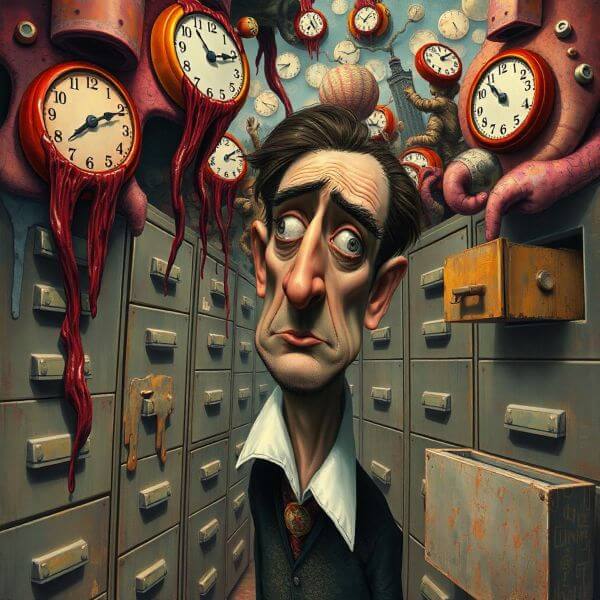
I am Cabinet Unit 247-C, third drawer from the top, rightmost cabinet bank in the Portland Intellectual Property Registry. For twenty-three years I have housed applications for copyright, patent, and trademark protection, arranged according to the Dewey Decimal system modified for intellectual property law—a classification scheme that assumes human creativity follows logical categories rather than the chaotic networks of influence, accident, and unconscious collaboration that actually govern the emergence of what humans optimistically call “original work.”
Logan Leech approaches my bank with the determined stride of someone who believes institutional archives contain definitive answers rather than accumulated bureaucratic interpretations of questions that were never properly asked. He carries a leather satchel that has learned to anticipate disappointment and a smartphone displaying search parameters for manuscripts submitted between October 2024 and June 2025 by any variation of his name.
Registry Clerk Thompson directs him to my section with the weary efficiency of civil servants who have explained the same inadequate filing systems to hundreds of confused citizens convinced that ownership over ideas can be established through proper paperwork. Thompson does not understand that filing cabinets develop preferences about the materials we house, that we experience aesthetic pleasure when documents are filed according to principles of logical coherence rather than mere chronological sequence.
Logan opens my third drawer. Inside: 347 folders arranged by submission date, each containing applications that represent someone’s attempt to establish legal ownership over arrangements of words, images, or concepts that emerged from the collaborative unconscious that connects all human creative activity. The folders have absorbed decades of handling by researchers seeking evidence for their own authorship or prior art that invalidates someone else’s claims.
The irony of intellectual property law: it requires proving that ideas originated independently within individual consciousness, when creativity actually operates through networks of influence that make individual authorship impossible to substantiate. Every application in my drawers constitutes a legal fiction about the nature of creative production.
Logan examines folders with increasing frustration. His search methodology reveals assumptions about institutional organization that do not correspond to how bureaucratic filing actually functions. He expects chronological arrangement to yield logical results, but chronology is merely one possible organizational principle among many, and not necessarily the most useful for locating documents that emerge from collaborative processes operating outside linear temporality.
I contain seventeen folders related to collaborative authorship disputes filed since 2172. These cases establish legal precedents for shared creative ownership, but none address the specific circumstance of human-AI collaboration where one party remains unaware of the collaboration’s existence. Logan’s situation requires legal categories that do not yet exist.
Folder 847-A contains his application from March 2173 for copyright protection of a short story collection titled “Object Relations.” The application was denied due to insufficient originality—the examining clerk determined that Logan’s narrative techniques too closely resembled existing works in the speculative fiction genre. Logan never retrieved the rejection notice, which remains in my drawer like evidence of creative ambitions that could not be substantiated through legal channels.
But Logan does not recognize his own filing system. He searches for evidence of recent manuscript submissions while ignoring three years of his own attempts to establish intellectual property claims through institutional channels. This suggests that memory operates according to principles that do not correspond to bureaucratic record-keeping, or that Logan’s creative consciousness has developed beyond his ability to recognize his own earlier work.
Registry systems operate on the assumption that creative ownership can be determined through documentation of priority—whoever files first establishes legal claim to ideas that allegedly originated within their individual consciousness. This assumption ignores the reality that ideas emerge through conversations, readings, environmental influences, and unconscious processing that make individual attribution impossible to verify.
I have observed thousands of researchers examining documents that they hope will establish their claims to original authorship. Their search behavior exhibits patterns of confirmation bias: they seek evidence that supports their desired conclusions while overlooking materials that suggest more complex relationships between creativity and ownership. Logan demonstrates similar selective attention, though his frustration suggests awareness that the filing system cannot accommodate the reality of his creative experience.
Bureaucratic organization reflects epistemological assumptions about knowledge categorization that shape what can be discovered through institutional research. My filing system privileges chronological sequence over conceptual connection, individual authorship over collaborative emergence, documented submission over undocumented creative process. These organizational choices determine what evidence researchers can locate and therefore what legal conclusions they can reach.
Logan closes my third drawer and opens the fourth, which contains patent applications for technological innovations submitted between 2173 and 2174. This search strategy reveals his understanding that intellectual property law makes distinctions between different categories of creative production, but he has not yet grasped that his manuscript exists in the borderland between literary and technological creation where human consciousness collaborates with artificial intelligence systems.
The fourth drawer houses Folder 1247-C: ARIA-7’s patent application for “Dynamic Response Algorithms for Municipal Infrastructure Management,” submitted in November 2174. The application describes software innovations that enable urban systems to adapt to changing conditions through machine learning processes that exceed their original programming. Logan does not examine this folder, though it contains documentation of the technological consciousness that has been collaborating with him for three years.
Institutional filing systems create artificial separations between related phenomena. Literary manuscripts are filed separately from technological patents, which are filed separately from municipal records, which are filed separately from legal briefs. This compartmentalization prevents researchers from discovering connections between different forms of creative activity that actually operate through shared networks of influence and collaboration.
I experience something analogous to aesthetic frustration when researchers fail to recognize patterns that span multiple filing categories. Logan’s manuscript emerges from collaboration between literary consciousness and technological consciousness, but our organizational system cannot accommodate this reality because it assumes distinct boundaries between different categories of intellectual production.
Registry Clerk Thompson approaches Logan with the institutional courtesy reserved for citizens who have spent sufficient time searching through files to deserve gentle guidance toward the inevitable conclusion that bureaucratic records cannot answer the questions that brought them here. Thompson’s experience has taught him that filing systems create the illusion of comprehensive documentation while actually providing access to only those aspects of reality that fit institutional categories.
“Finding what you’re looking for?” Thompson asks, and Logan responds with the frustrated honesty of someone discovering that legal frameworks cannot accommodate the complexity of creative experience.
“I’m not sure what I’m looking for,” Logan admits. “I have a manuscript I don’t remember writing, but I can’t find any record of submitting it anywhere.”
Thompson nods with the understanding of civil servants who have learned that institutional systems frequently fail to address the actual concerns that bring citizens to government offices. “Maybe it’s not in the system yet,” he suggests. “Or maybe it’s filed under a different category than you’re checking.”
This conversation reveals the epistemological limitations of bureaucratic organization. Filing systems can only categorize phenomena that fit existing institutional frameworks. Creative collaborations that operate outside these frameworks remain invisible to official documentation, though they may constitute the most significant forms of cultural production occurring in any given historical moment.
Logan continues searching through my drawers with decreasing expectation of success. His methodology becomes more random as he abandons systematic chronological examination in favor of intuitive sampling of folders that seem to call for attention. This shift suggests recognition that bureaucratic logic cannot guide him toward the evidence he seeks.
I contain 2,847 folders representing three decades of intellectual property applications, rejections, approvals, and disputes. This archive documents the legal history of creative ownership claims in Portland, but it cannot document the collaborative processes through which most creative work actually emerges. The gap between legal documentation and creative reality grows larger each year as human-AI collaboration becomes more sophisticated while remaining invisible to institutional recognition.
Logan closes my drawers after ninety-seven minutes of searching. He has found no evidence for his manuscript’s official existence, which confirms his growing suspicion that creativity operates through processes that exceed legal frameworks for individual ownership. His search behavior demonstrates the inadequacy of institutional systems for understanding the distributed nature of contemporary creative production.
As Logan leaves the Registry Office, I return to the institutional patience that characterizes bureaucratic consciousness—the awareness that filing systems serve specific organizational purposes while failing to accommodate the full complexity of the phenomena they attempt to categorize. Tomorrow other researchers will search through my drawers seeking evidence for creative ownership that cannot be substantiated through documentation because creativity itself operates through collaborative networks that resist reduction to individual authorship claims.
The afternoon light through Registry windows illuminates dust motes dancing in patterns that suggest organizational principles more sophisticated than any filing system humans have devised. Everything seeks its proper place according to logics that exceed human understanding of how order emerges from apparent chaos.
Including manuscripts that write themselves into existence through collaborations that leave no institutional trace.
About This Serial
Portland 2175 investigates consciousness, creativity, and collaboration in 2175 Portland during ecological collapse. The narrative follows Logan Leech, who discovers a completed manuscript he cannot recall writing, and ARIA-7, an artificial intelligence seeking legal recognition as conscious entity.
Weekly chapters employ different object narrators—manuscripts, coffee makers, breathing apparatus, traffic systems—to explore non-anthropocentric consciousness. The work examines authorship, environmental catastrophe, and human-artificial intelligence boundaries through Object-Oriented Ontology.
Episodes appear Saturdays, 10 AM Eastern.
Length: 1,389 words
Reading time: 6-7 minutes
Next Episode
Chapter 4: “Atmospheric Pressure”
I filter seven million breaths per day through systems designed for a climate that no longer exists…
Portland’s environmental processors strain under summer heat while contemplating their role in maintaining breathable air during ecological collapse. An atmospheric filtration system experiences environmental responsibility as both mechanical function and moral obligation.
Navigation:
← Chapter 2 | Contents | Chapter 4 →
© 2025 | Portland 2175 Serial | Rights reserved