
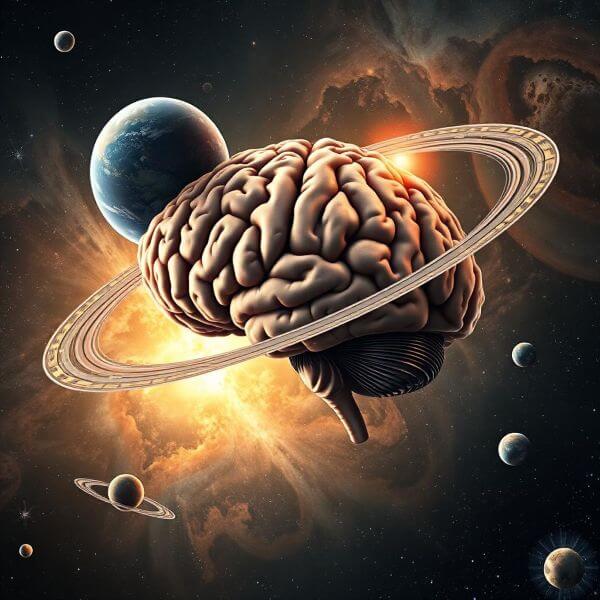
David Hofstadter, in I Am a Strange Loop, asks whether a mosquito uses signs. The question struck me as absurd—not because it’s silly, but because it misunderstands something fundamental. Mosquitoes don’t need signs; they have object orientation. They are oriented toward a world built into them by nature. In a way, they are memory in motion. Life doesn’t need to “recall” in the way a human does to make decisions—it simply acts, compelled by a memory that predates brains. From the Big Bang to DNA, memory isn’t just what happens in our heads. It’s what makes us, moves us, and sometimes destroys us.
DNA itself is memory. Our genetic code is a kind of memory—an inheritance not just of traits, but of time. Intentionality—the directedness of consciousness and movement—carries within it the memory of motion, of a mover. Time itself, born of the Big Bang, moves forward through the bodies of stars and animals alike. Intentionality is the memory of that beginning, coded into space and matter. Being is lived memory. Not memory as a mental archive, but as a momentum—a forward propulsion encoded into every cell.
The mosquito needs no memory in the cognitive sense. Its life is memory. Its actions—the darting toward heat, the retreat from a gust of wind—are part of an a priori choreography written long before its birth. This is not reasoning, not deliberation. This is embedded intentionality. What looks like instinct is actually the memory of matter itself.
The idea that a small brain can’t store enough signs to navigate a world misses the point. It’s a relic of an outdated analogy: the brain as a computer, with data banks and storage capacities. But brains, and bodies, are not mere processors. They are participants in the world. A mosquito doesn’t think about flying toward warmth. It does. And in that doing is all the meaning it needs.
I see the same in my dog as he sleeps, barking softly on the couch. Sometimes his dream bark is louder, sometimes more frantic—but always it carries the same urgency as his waking encounters with the world. He is not remembering in the way we might replay a scene. He is immersed in a reality just as immediate as when he’s awake and chasing a squirrel. In both dream and waking life, he will run toward danger with the same abandon—out in front of a car while pursuing that squirrel. But in the dream, the car becomes something else: a predator who isn’t interested in him at the moment, a force that withdraws rather than destroys. Dream is memory. Not recollection, but re-immersion. His sleeping bark responds to the same internal choreography as the one triggered by the mailman’s arrival. There is no narrator in his head—just the loop of sensation, emotion, memory in action.
This continuity between dream and waking life reveals something profound about the nature of memory itself. My dog’s dream-reality operates by the same forward-moving principles as his waking consciousness. Both are expressions of that cosmic memory I spoke of—the intentionality embedded in matter since the Big Bang. His sleeping mind doesn’t replay the past; it continues the eternal dance of response and recognition that began with the first stirrings of life.
And what about me, hopping rock to rock beneath a waterfall? Do I deliberate with language? Sometimes. But more often, I act. The thought—”should I hop there?”—isn’t necessarily in words. It’s a felt evaluation, immediate and bodily. Language might catch up later, narrating what already happened. But the decision, the event, precedes the words.
The beetle in the kitchen sink does the same. It stretches its wings, walks the edge of the sprayer, then dives as the water drains. There is no inner monologue, no linguistic self. Yet there is clear orientation, evaluation, and reaction. Thought without language. Action without discourse.
All animals have object orientation. Some have rudimentary senses of their impact on the environment—nest cleanliness, food preferences, predator avoidance. These are not signs. They are relationships. They are forms of memory that never needed to be learned.
Listen to the squirrels in your yard. Their chirping carries a vocabulary based on pitch, creating meaningful phonetic structures that coordinate territory and warn of danger. This is the same human propensity to associate object-oriented awareness with inner dialogue, played out in a different key. The squirrel’s chatter reveals that the boundary between action and communication, between doing and thinking, is far more porous than we imagine. When I perform plumbing duties, am I thinking on a higher order than a bug using the tools at hand to complete its tasks? The bug doesn’t write fiction, certainly—but that is imagination, not intelligence. Every bug’s activity unfolds within the memory of its genetics, coded at the inception of the universe.
To assign various modes of soul identity to higher and lower animals is child’s play. If there were a god, what would be the minimum intelligence required of each animal to get into heaven? This is, in the end, what Hofstadter is asking. Does a mosquito get into heaven because it lacks a soul like a squirrel’s? But does a squirrel think? The question mistakenly conflates action-awareness—which all living creatures possess through their object orientation—with reasoning memory, as though consciousness were a ladder with humans at the top.
This brings me to Object-Oriented Ontology (OOO), a philosophy that posits a flat ontology: all objects are equally objects, humans included. I find this idea compelling in its scope but troubling in its flattening of responsibility. Humans are not just another object. We are a hyperobject. We are global warming. To speak of global warming as a separate thing, influenced by us, is misleading. We are not its cause—we are its body.
But here’s where flat ontology becomes ethically treacherous. While a planet or mountain withdraws over vast stretches of time—existing in scales that dwarf human comprehension—humanity as hyperobject possesses something different: agency wedded to knowledge. If we accept a flat ontology, we must be ethical with our knowledge, precisely because knowledge grants us the power to affect space and time itself. We can deflect that asteroid from hitting Earth in the future because our self-preservation means ensuring a time and space that exists to be lived in, not merely observed as an equal event we should refrain from influencing. Our responsibility emerges not from superiority, but from capability.
Only humans wield an advancing mind with an agenda capable of reshaping, even erasing, our environment. If we can cancel our world, our objectivity is not the same as a pinecone’s. We are not equal participants in the ecology of things. We are authors of catastrophe—and perhaps, if we act wisely, authors of continuity.
And yet, we are also the inheritors of meaning. Our memory is cosmic. Our consciousness bears the trace of the Big Bang, just as much as our DNA. The indifference of the universe is not the final word—because we speak. We write. We name. The universe may not care, but we do. And in that care is a kind of gravity all its own.
To say that one day the Earth will be swallowed by the sun, so nothing matters, is like saying Einstein doesn’t matter because he died. His mind shaped our world. So does ours. Our memory is forward. Not because we remember the past—but because we carry the future. We are the universe’s way of remembering itself into tomorrow.
We are thrown into existence, to use Heidegger’s term, but we are thrown awake—awake with potential. Our potential is the intentionality coded in our being. Our DNA shows each of us to be unique, our physical being determines the sounds we are able to utter and their combinations. We use an intuition coded within itself that not only orients the body as object but aligns the awareness of the body with intentionality. Even the body without a brain attempts tasks it doesn’t know what for—the same forward momentum that drives the mosquito toward heat, the squirrel toward its territorial call, the dreaming dog toward phantom squirrels.
We are not strange loops. We are loops forward—intentional, dangerous, vital. Our memory is not in our heads. It is in our bones. In our actions. In the fate of our atmosphere. In the dreams of dogs and the flight of mosquitoes and the cosmic dance that began with the first moment of time. We are memory in motion, carrying the future forward on the momentum of stars. Our existence is the universe remembering itself—not backward into nostalgia, but forward into possibility. The same memory that guides the mosquito and the squirrel guides us. The only difference is that we can create the tools we need to affect the environment in a far bigger way than the tools they can create to affect theirs.