
Animal Semiotics: Signs of Communication in a Non-Human World
Introduction:
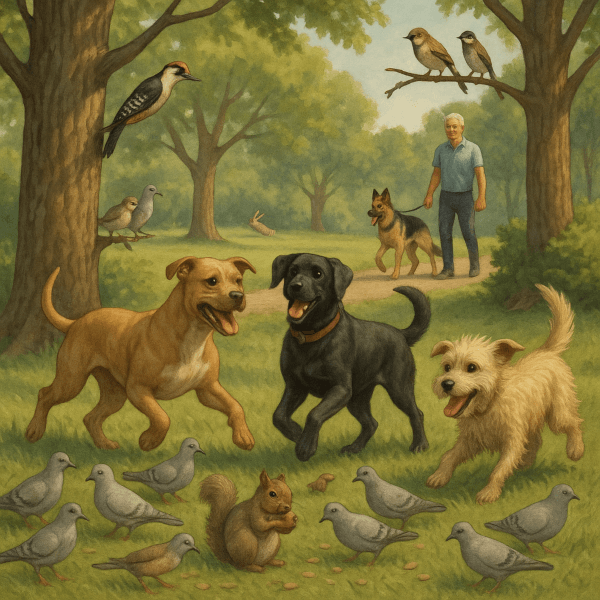
Semiotics, the study of signs and symbols and their use in communication, is most often associated with human language but can also be used to study animal behavior. Animals, like humans, use signs, including visual, auditory, and olfactory cues, to communicate their presence, intentions, and territorial claims. Phenomenology offers a way to understand how animals’ bodies are situated in their environment and use unique markers to give clues about their identity, mode of being, such as whether the animal’s mark communicates that it is a predator or likely non-violent, and its health. Dogs communicate by exchanging scents, which indicate their health, age, and personality. Squirrels leave markings to signal their presence to others, while maintaining a communal feeding area where many squirrels come to eat side by side, and where birds take turns perching on a cake of suet. The birds communicate through a system of chirps, with tone variations to convey meaning, danger, food, and the presence of friendly visitors.
Section 1: The Language of Dogs
Along the walking trail, dogs leave scent marks as a form of communication rather than signs of dominance, which is a human concept. No birds are taxing other birds for food, nor is there a seed and nut tax for the squirrel king. When a dog leaves its scent, it’s like dropping a note and saying, “Hey everyone, this is me. I am a 3-year-old, neutered, overweight, but generally healthy male. I don’t have many aches and pains. My owner lets me out regularly and often gives me table scraps. I’m not anxious, and I get along well with most dogs and cats.” The dog is also marking its route or territory if it’s aggressive. This behavior is similar to what we see in high school: nobody wants to walk past the bully’s locker, sit with him in class, or pretend to be his friend. They are loners. Dogs also communicate by interpreting the tone of their bark. Barking signals many things: help, hello, stay away, I want to hurt you, I am hungry, I am thirsty, I need to go out, I want to play. A dog’s body language also speaks—whether they are excited, happy, sad, bored, tired, irritated, or frightened. Through their body language, dogs speak a universal language of emotions. This isn’t just about human feelings but also about the emotions many animals display and are conscious of expressing. A dog learns acceptable behavior based on the reactions it receives. It understands the universal signs of cognition, as expressed in human signs and symbols. It can relate to similar emotions and awareness of its own cognition as humans do, translating human signals into canine ones. This would be impossible without universal signs of emotions that are recognizable to every intelligent creature.
Section 2: Squirrels and Territory Marking
Like dogs, squirrels also use scent to form social bonds and mark their territory. They employ an intricate system of barks, screams, squeaks, squeals, and clucks to alert others about specific types of snakes and aerial predators, as well as to express joy, fear, distress, and pain. Squirrels also communicate through body language to actively and passively share their intentions, emotions, and social interactions using posture and stance, much like humans do. Additionally, squirrels are social animals that maintain a system of signals to build community bonds, share food, and defend one another. They convey intentionality, nurturing, and intuition—qualities that are only possible if a being is aware of itself and its intentions. Recognizing one’s intentions leads to signs that carry meaning.
Section 3: Birds and the Acoustic Sign System
The dove has many friends. Swallows, blue jays, squirrels, or rabbits can all be found feeding near the dove. Doves manage to survive despite lacking the body of a predator. They show awareness by feigning injury to distract aggressors. Doves use voice inflections to coordinate in their group, saying things like, “move aside, let me get some. Ok. Well, hurry, I am hungry! Wait a few more pecks, okay. The nest is southwest of here. Here comes a squirrel.” A wing shriek prompts the flock to take off, signaling the presence of a predator. Once safe, the flock notices a hawk’s shadow. Doves can blend with weeds and stand still for fifteen minutes to avoid detection, demonstrating calculating awareness. They further utilize this awareness to understand and convey signs with group interaction. Doves also intuitively respond to universal signals when feeding in the presence of squirrels or snakes. They understand claw and paw clues, read tree markings, and interpret body language. They estimate the age of nests and seeds, and assess the quality of water and air. Their language is both personal and universal, intuitive.
Section 4: The Subtle Semiotics of Cats
Cats, within their territory, also use signs, but their application of semiotics is often subtler and more mysterious. They leave scent marks and perform behaviors that indicate their ownership of a space. Cats rid homes of mice not by eating them but by establishing dominance through scent marks, creating signals that mice interpret as threats. These semiotic markers operate in the mice’s phenomenological world, warning them of predators’ presence. Cats also use a range of vocalizations, including meows, growls, spitting, screeching, howling, and purring, which they adjust in pitch to convey meaning. One cat will meow to implore an owner to stop yelling at another cat, meow in a different way to request a toy, or food. Cats exhibit cognitive awareness and intentional behaviors within groups. Their body language speaks the universal language of awareness and intentionality, conveying emotion and memory.
Section 5: Phenomenology and Semiotics: Interpreting the Non-Human World
Humans and other animals share a universal sign system that defines our environment. Each species and individual uses these signs when interacting with other living and aware beings to express intentions and describe situations. Dogs, squirrels, birds, and cats all communicate similar meanings while interacting within their own language systems: excitement, pain, fear, happiness, sorrow, and danger. They also use signs for specificity, describing things like the type of bird or snake, a predator’s location, or the direction it moved. They can communicate among themselves that a particular seed or nut tastes better or worse from different areas, that danger is approaching from a specific direction, or that they dislike some characteristics of each other.
Conclusion:
By recognizing universal signs used in the language systems of all species, we can better understand how to be responsible stewards of the environment. All animals share an awareness of their surroundings and express this through a system of universal signs that convey meaning across different species. Each species uses its own group-specific language of signs to communicate descriptions, definitions, and awareness. Dogs, squirrels, birds, and cats all demonstrate awareness of the same signs that express emotion. A cockatiel will wail at the death of a mate. A horse will pace at the loss of a friend. We understand the meaning of these signs because they are universal. Because we share a common language, we can apply our knowledge of the needs of all species on earth and in the sea to honor their right to exist, extend a courteous hand as stewards of the environment, and bring species together through the study of species-specific languages and the sign systems they use to exchange knowledge and meaning.
Further Reading: The Writer’s Phenomenology: Husserl’s Toolkit for Character Development, Walking Is Thinking: A Phenomenological Essay On Mind, Body, and Everyday Life, and Winston’s Gaze: A Meditation On Consciousness Across Species.